
Table of Contents
- The Science Behind Overheating—Understanding Joule Heating and Electrical Resistance
- The Three Primary Causes of Outlet Overheating
- By the Numbers—The Statistical Reality of Electrical Fires
- Critical Steps to Take Right Now (Before Calling an Electrician)
- The Hidden Dangers Behind Your Walls (And Why DIY Can Make Things Worse)
- Final Thoughts
Every year, nearly 46,700 home fires in the United States are caused by electrical failures, resulting in hundreds of deaths and over $1.5 billion in property damage. One of the earliest warning signs? An electrical outlet that feels warm—or worse, hot—to the touch. If you’ve ever noticed heat radiating from a wall outlet, you’ve encountered a critical safety red flag. What starts as mild warmth can quickly escalate into melted plastic, sparking wires, and catastrophic house fires. For homeowners in Portland, Oregon, and Vancouver, Washington—where mid-century housing stock is common—the risks are even more pronounced due to aging wiring systems and outdated materials like aluminum wiring. At Sarkinen Electrical, we’ve seen firsthand how a seemingly minor issue can cascade into emergency electrical repairs and devastating property damage. This comprehensive guide explains why outlets overheat, identifies the most common culprits, and provides you with immediate safety protocols to protect your home and family. Whether you’re dealing with loose connections, overloaded circuits, or decades-old aluminum wiring, understanding the science behind electrical overheating empowers you to act swiftly and decisively.
- The physics of why outlets generate heat (Joule heating and electrical resistance)
- The three most common causes of outlet overheating
- Immediate safety steps to take when you discover a hot outlet
- Why DIY repairs are dangerous—and when to call a licensed electrician
The Science Behind Overheating—Understanding Joule Heating and Electrical Resistance
What Actually Causes an Outlet to Overheat?
Most homeowners don’t realize that electrical heat isn’t random—it’s governed by fundamental physics. Understanding why outlets overheat is the first step in recognizing the danger signs. When electricity flows through a conductor, it encounters resistance. This resistance converts some of the electrical energy into heat—a phenomenon known as Joule heating or resistive heating. According to Joule’s First Law, the heat generated in an electrical circuit is proportional to the square of the current multiplied by the electrical resistance. In plain terms: when electricity encounters resistance, it produces heat.
Normal vs. Abnormal Operation
In normal operation, modern copper wiring and properly functioning brass contacts have extremely low resistance, allowing electricity to flow smoothly without generating noticeable heat. The outlet might feel slightly warm after extended use of a high-wattage appliance, but it should never feel hot to the touch. Abnormal operation occurs when resistance increases—due to loose connections, corroded wires, or worn-out receptacle contacts. The electrical energy that can’t pass through efficiently is expelled as heat. This isn’t just uncomfortable warmth; localized heat can quickly exceed 300°F, hot enough to melt plastic faceplates, ignite drywall paper, and cause electrical arcing.
Why This Matters for Pacific Northwest Homes
Homes built before 1980 in the Portland-Vancouver area often contain aging electrical infrastructure. As these systems age, resistance naturally increases, making overheating more likely. The combination of decades-old wiring, repeated thermal cycling from our region’s temperature fluctuations, and moisture exposure from our rainy climate creates a perfect storm for electrical failure. The heat you feel at an outlet isn’t just a comfort issue—it’s a measurable indicator that electrical resistance has increased beyond safe operating parameters. Left unchecked, this leads to component failure and fire risk. The National Institute of Standards and Technology has documented countless electrical fire investigations where the root cause traced back to increased resistance at connection points.
The Three Primary Causes of Outlet Overheating
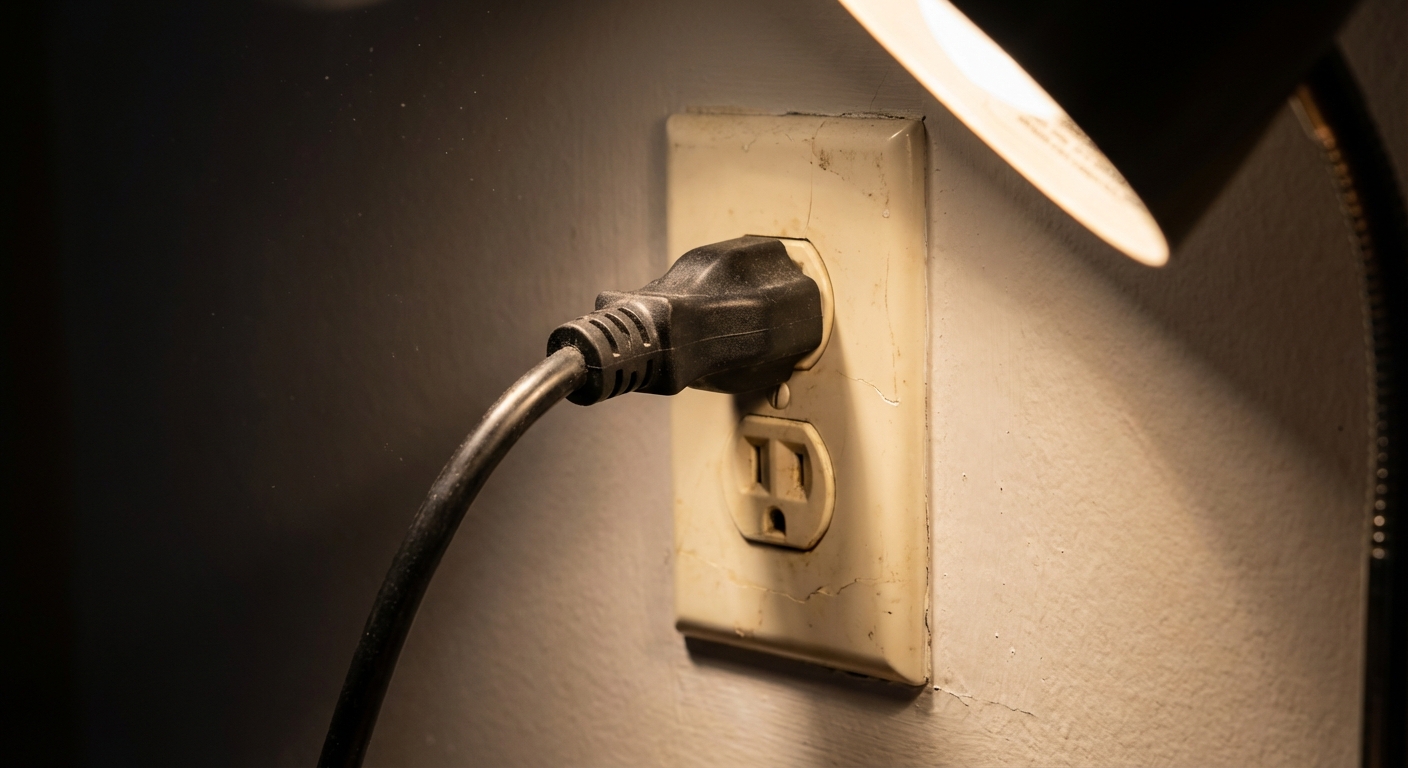
What’s Really Happening Behind Your Walls?
Overheating outlets don’t fail randomly. Three distinct mechanical and electrical failures account for the vast majority of cases—and each one escalates fire risk exponentially.
Deteriorating Internal Contacts (Mechanical Fatigue)
Standard 15-amp and 20-amp receptacles use internal brass tension clips to grip plug prongs securely. These clips create a tight metal-to-metal connection that allows electricity to flow with minimal resistance. The Fatigue Process: After years of repeated plug insertion and removal, these clips lose their tension, reducing the contact surface area between the plug prong and the internal metal. Think of it like a spring that’s been compressed thousands of times—eventually, it stops springing back with the same force. The Result: Decreased contact area equals increased electrical resistance, which equals dangerous heat buildup. As the clip weakens, the plug makes contact with less and less of the brass surface. The electricity must flow through this smaller contact point, concentrating resistance and generating intense localized heat.
Overloading Circuits and High-Demand Appliances
Circuits are rated for specific amperage limits, typically 15 or 20 amps for residential outlets. These ratings exist for safety—they represent the maximum current the wiring can safely carry without overheating. The Problem: High-demand appliances like space heaters (1,500 watts / 12.5 amps), hair dryers, and window AC units can push a circuit to its maximum threshold without tripping the breaker. The circuit might be operating within its rated capacity from an amperage perspective, but if the outlet itself has degraded contacts, that concentrated current flow generates dangerous heat. Why Breakers Don’t Always Trip: Circuit breakers protect the wiring in your walls from overload, not individual outlets from local overheating. If the total circuit load stays just below the breaker’s threshold, the breaker won’t trip—but the outlet itself can still overheat if its internal contacts are worn. The breaker has no way of detecting that a single outlet is generating dangerous heat while the overall circuit current remains within limits. The U.S. Consumer Product Safety Commission warns that portable space heaters are among the most frequent culprits in outlet meltdowns, accounting for thousands of residential fires annually. These devices draw sustained high current for hours at a time, continuously stressing any weak points in the electrical connection.
Aluminum Wiring in Mid-Century Homes (1965–1973)
Between 1965 and 1973, high copper prices led builders to use solid aluminum wiring in residential construction—extremely common in Portland and Vancouver-area homes from this era. If your home was built during this period, there’s a significant chance it contains aluminum wiring. Cold Creep: Aluminum expands and contracts with temperature fluctuations far more than copper. Every time current flows through the wire, it heats up slightly and expands. When the current stops, it cools and contracts. Over thousands of heating and cooling cycles, this causes connections at screw terminals to gradually loosen—a phenomenon known as “cold creep.” Galvanic Corrosion: Aluminum oxidizes rapidly when exposed to air. Unlike copper oxide, which remains electrically conductive, aluminum oxide is an insulator. This oxide layer dramatically increases resistance at connection points, generating extreme heat. The problem compounds over time as heat accelerates oxidation, which increases resistance, which generates more heat—a dangerous feedback loop.
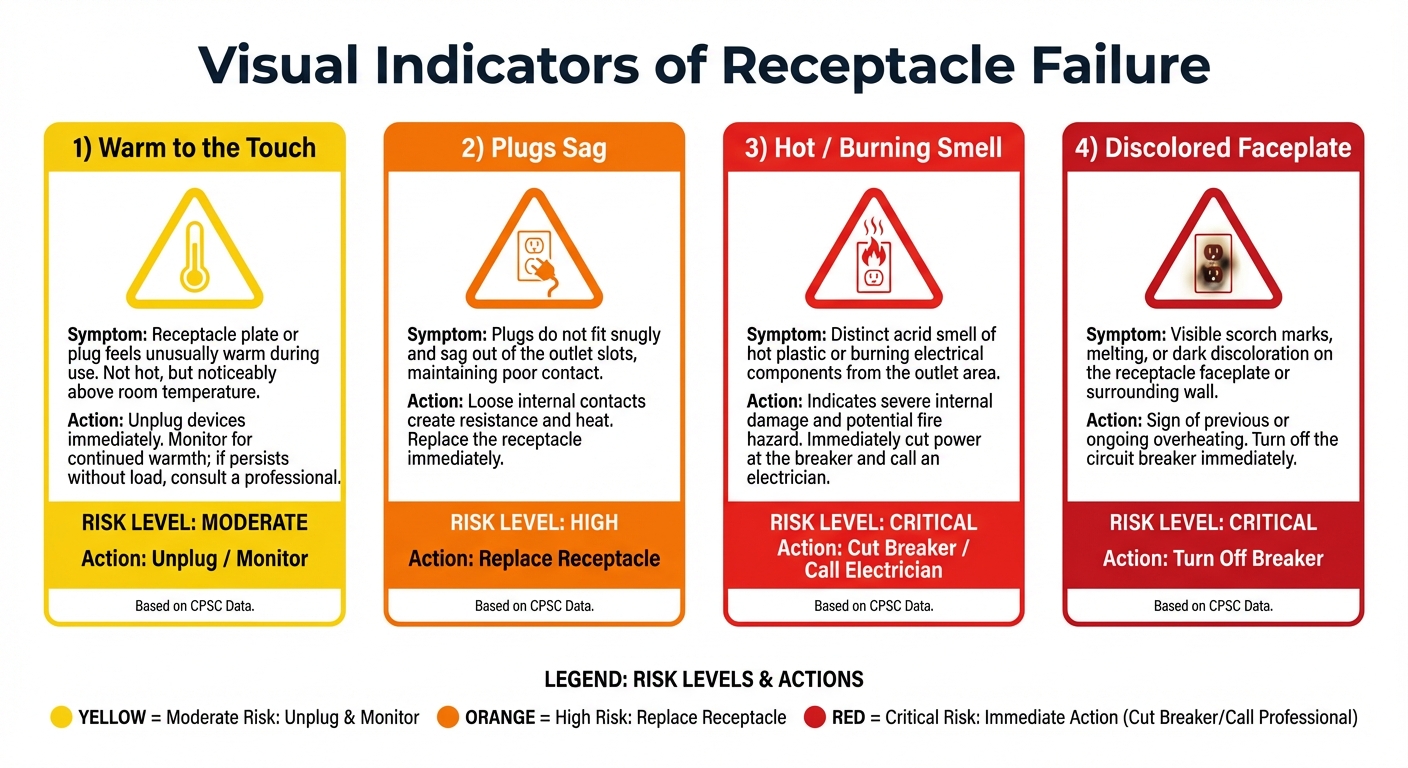
The Space Heater Meltdown: A Real-World Case Study
Consider this scenario we encountered in a 1970s Portland-area home: A homeowner plugs a 1,500-watt space heater into a bedroom outlet. The heater draws 12.5 amps on a 15-amp circuit—within the breaker’s limit, so everything seems fine. However, the receptacle’s internal contacts are 40+ years old and loose. The high continuous current passing through the degraded connection generates localized heat exceeding 300°F. Over the course of several hours, the plastic faceplate begins to soften and melt. The internal wiring insulation breaks down, and the exposed wires begin arcing—creating small electrical sparks that ignite the drywall paper behind the outlet. By the time the homeowner noticed the burning smell, significant damage had already occurred behind the wall. The drywall was scorched, wire insulation had melted back several inches from the outlet box, and the wall cavity was beginning to smolder. Professional Remediation: Our electrician replaced the charred receptacle, trimmed the oxidized wiring back to clean copper, inspected adjacent outlets on the same circuit, and upgraded the bedroom circuit to an Arc-Fault Circuit Interrupter (AFCI) breaker—designed to detect arcing signatures and shut off power before fires start. The homeowner also received education about not using high-wattage space heaters with extension cords or in outlets showing any signs of wear.
By the Numbers—The Statistical Reality of Electrical Fires
Why Ignoring a Hot Outlet Could Cost You Everything
National fire safety data reveals the devastating human and financial toll of electrical failures—and why immediate action is non-negotiable.
National Fire Statistics
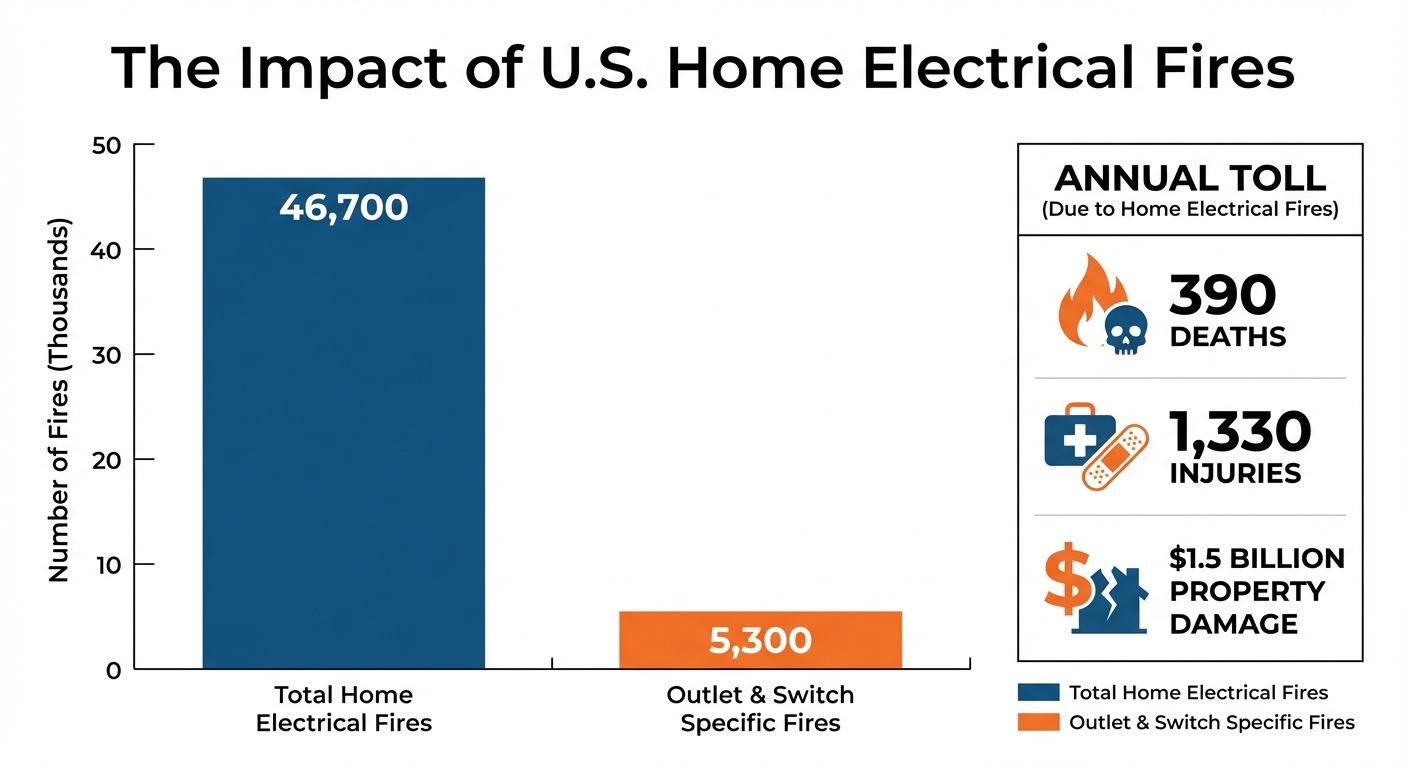
The numbers are sobering. According to the National Fire Protection Association and the U.S. Consumer Product Safety Commission:
- 46,700 home fires involving electrical failure or malfunction occur annually in the U.S.
- These fires result in 390 civilian deaths every year
- 1,330 civilian injuries are attributed to electrical fires annually
- $1.5 billion in direct property damage occurs each year from electrical fires
Even more specifically, electrical receptacles and switches are directly involved in approximately 5,300 fires per year, causing 40 deaths and over $40 million in property damage. These aren’t abstract statistics—they represent real families who lost loved ones, homes, and irreplaceable possessions because a warm outlet was ignored.
The Portland-Vancouver Context
The Pacific Northwest has a high concentration of mid-century housing stock built between the 1950s and 1970s. Many homes in Portland and Vancouver contain original electrical systems that were never upgraded to modern safety standards. These systems were designed for a different era—before homes had multiple computers, large-screen televisions, charging stations for electric vehicles, and the countless other electrical demands of modern life. The infrastructure that adequately served a 1960s household is now severely overtaxed. Aging Infrastructure Risk: Homes over 40 years old face exponentially higher risks of loose connections, corroded wiring, and outdated circuit protection. The wiring insulation becomes brittle, connections loosen from thermal cycling, and receptacles wear out from decades of use. What was once a perfectly safe electrical system has degraded to the point of being a potential fire hazard.
Why Homeowners Delay Action
Many homeowners dismiss warm outlets as “just old wiring” without understanding the underlying physics of electrical failure. We frequently hear: “The house is old, everything’s a little warm” or “It’s been like that for years.”
The Electrical Safety Foundation International emphasizes: “Electrical fires don’t announce themselves with alarms or warnings—they start silently, behind walls, in the middle of the night. A warm outlet is your only early warning system.”
Critical Steps to Take Right Now (Before Calling an Electrician)
Immediate Safety Protocol—What to Do When You Discover a Hot Outlet
When you discover an overheating outlet, every second counts. Following this safety protocol can prevent fires, injuries, and property damage. Don’t panic, but do act decisively.
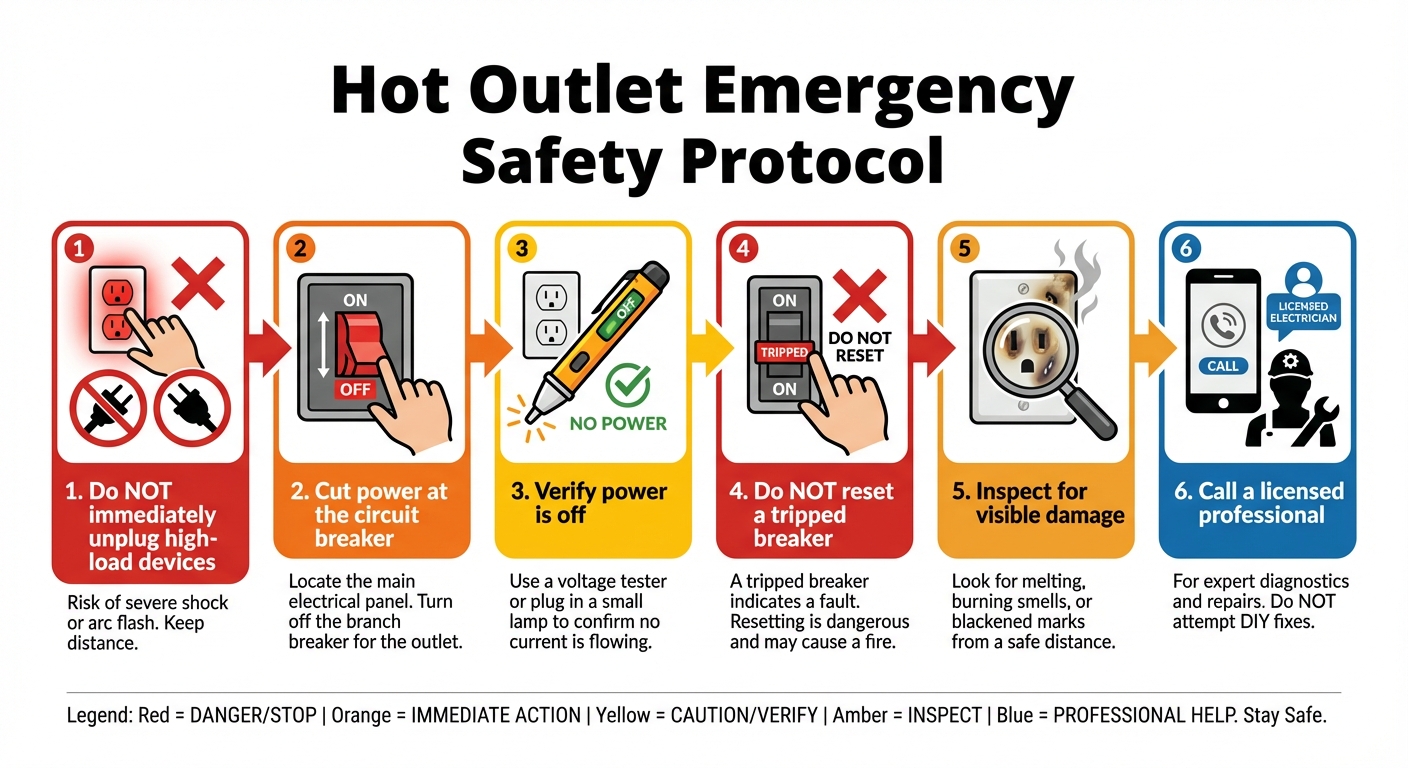
Step 1: Do NOT Immediately Unplug High-Load Devices
If an outlet is actively sparking, smoking, or melting, unplugging a device can create a dangerous electrical arc—essentially a flash of electricity that can cause severe burns. The act of breaking the electrical connection while current is flowing can generate temperatures exceeding 3,000°F in a fraction of a second. Exception: If the device can be safely unplugged without forcing it, remove it gently. If you feel any resistance or hear crackling sounds, stop immediately and proceed to Step 2.
Step 2: Cut Power at the Circuit Breaker
Immediately go to your electrical panel. Time is critical, but safety is paramount—don’t run, but move quickly and deliberately. Identify and switch off the breaker controlling the affected outlet. If your panel isn’t labeled (and many aren’t), you have two options:
- If you have time and the situation isn’t actively smoking or sparking, you can test outlets with a lamp to find the right breaker
- If the situation is urgent, turn off the main breaker to cut power to the entire house temporarily
Step 3: Verify Power is Off
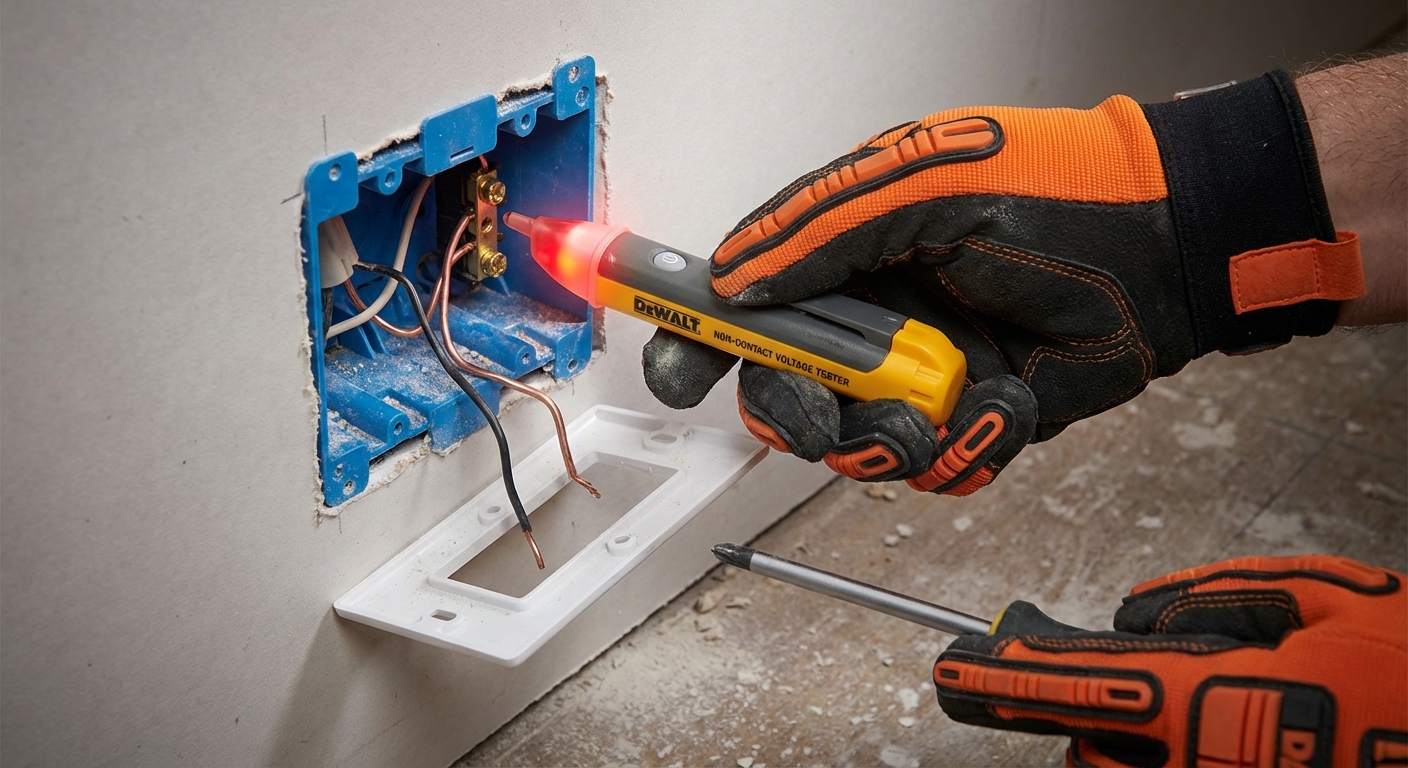
Never assume a breaker cut power correctly. Breakers can fail, or you may have switched off the wrong one in the stress of the moment. Use a non-contact voltage tester (available at any hardware store for under $20) to confirm the outlet is de-energized. These simple devices light up or beep when they detect electrical current—even through plastic outlet covers. Hold the tester near the outlet. No light or sound means it’s safe to proceed.
Step 4: Do NOT Reset a Tripped Breaker
If the breaker tripped on its own (rather than you manually switching it off), it’s doing its job by protecting you from a dangerous electrical fault. The breaker detected an abnormal condition—likely a short circuit or ground fault—and interrupted power to prevent fire or electrocution. Resetting a tripped breaker without professional inspection can cause fires, equipment damage, or electrocution. The underlying problem that caused the trip still exists. Resetting the breaker is like silencing a fire alarm without addressing the fire.
Step 5: Inspect for Visible Damage
With power confirmed off, carefully examine the outlet and surrounding area. Look for:
- Discoloration: Brown, black, or melted plastic around the outlet opening or faceplate
- Burn marks: Charring on the wall, outlet cover, or visible through the outlet openings
- Burning smell: An acrid, plastic odor that lingers even after power is cut
- Loose plugs: Signs that plugs previously sagged or fell out easily
- Deformed plastic: Warping, bubbling, or melting of the outlet faceplate
- Visible sparking residue: Black carbon deposits around the contact points
Take photos of any damage you observe. These will be helpful for your electrician and potentially for insurance documentation.
Step 6: Call a Licensed Electrician Immediately
This is not a DIY repair. Heat damages wire insulation behind walls in ways that aren’t visible from the outside. A professional electrician must:
- Remove the damaged receptacle and inspect the outlet box
- Trim wiring back to uncompromised insulation (often 6-12 inches behind the visible damage)
- Test the circuit for additional faults
- Replace the receptacle with a code-compliant unit
- Inspect the entire circuit for hidden damage
- Verify proper grounding and circuit protection
Don’t wait until tomorrow, next week, or “when you have time.” Electrical failures escalate exponentially. What’s a minor problem today can be a house fire tonight.
The Hidden Dangers Behind Your Walls (And Why DIY Can Make Things Worse)
Why Professional Repair is Non-Negotiable
Replacing an overheated outlet isn’t a simple swap—it requires assessing hidden damage, understanding electrical code, and preventing future failures. What looks like a straightforward replacement from the outside involves complex evaluation of unseen conditions.
What Happens Behind the Walls
When an outlet overheats, the damage extends far beyond the visible faceplate. The heat radiates through the outlet box and into the wall cavity, affecting wiring and connections you can’t see without removing drywall. Wire Insulation Degradation: Chronic heat exposure causes wire insulation to become brittle, crack, and expose bare copper—creating future arc-fault and fire risks. Modern thermoplastic insulation begins degrading at temperatures around 140°F. An outlet generating 300°F creates a zone of heat damage extending several inches (or even feet) along the wire. The insulation may look fine from the outside but has lost its electrical integrity. Flex the wire slightly, and it cracks, exposing bare copper. Leave it in place, and it will eventually fail—often at the worst possible time. Connection Point Corrosion: Aluminum wiring, in particular, forms insulating oxide layers that aren’t visible to the untrained eye. A connection that looks clean and shiny may have a microscopic layer of aluminum oxide acting as an insulator, creating the exact high-resistance condition that caused the initial overheating. Professional electricians use specialized tools to identify these problems:
- Thermal imaging cameras to detect heat patterns in walls
- Insulation resistance testers to measure wire integrity
- Contact resistance meters to evaluate connection quality
Code Compliance and Modern Safety Standards
Electrical codes evolve based on decades of fire investigation data. Simply replacing a failed outlet with an identical unit doesn’t address the underlying safety issues that caused the failure. Arc-Fault Circuit Interrupters (AFCIs): The National Electrical Code (NEC 2020 and later) requires AFCI protection in bedrooms, living rooms, hallways, and other high-risk areas. These specialized circuit breakers detect the unique electrical signature of arcing—the rapid, repetitive sparking that precedes most electrical fires—and shut off power before ignition occurs. Traditional circuit breakers respond to sustained overcurrent or short circuits. AFCIs detect the microsecond electrical signatures of loose connections, damaged insulation, and other arc-producing faults. It’s the difference between detecting a forest fire after it starts versus detecting the sparks before they ignite. GFCI Requirements: Kitchens, bathrooms, garages, basements, and outdoor outlets must have Ground Fault Circuit Interrupter (GFCI) protection to prevent electrocution. GFCIs detect current imbalances—indicating electricity is flowing through an unintended path, like a human body—and interrupt power in milliseconds.
The Cost of Cutting Corners
DIY electrical repairs are tempting from a cost perspective, but the risks far outweigh potential savings. DIY Risks include:
- Improper wire stripping: Leaving exposed copper too short creates weak connections that overheat. Leaving it too long creates potential short-circuit hazards.
- Incorrect wire gauge selection: Using 14-gauge wire on a 20-amp circuit (which requires 12-gauge) creates an immediate fire hazard.
- Failure to identify aluminum wiring hazards: Aluminum requires special connectors and techniques. Standard wire nuts designed for copper will fail on aluminum, creating the exact overheating condition you’re trying to fix.
- Inadequate torque on screw terminals: Too loose creates high resistance; too tight can damage the wire or receptacle.
- Missing or improper grounding: Compromises shock protection and can make GFCI/AFCI protection ineffective.
What a Professional Inspection Includes
When you call Sarkinen Electrical for an overheated outlet, we don’t just replace the receptacle. Our comprehensive evaluation includes:
- Thermal imaging to detect hidden hot spots in walls and identify other at-risk outlets on the same circuit
- Voltage testing to ensure proper grounding, neutral connections, and circuit protection
- Load analysis to determine if circuits are appropriately sized for their protective devices and connected loads
- Full circuit tracing to identify shared circuits that may be contributing to overload
- Outlet box inspection to verify proper mounting, adequate space, and absence of combustible materials
- Wire condition assessment including insulation integrity testing
- Connection resistance testing to identify high-resistance connections before they fail
Every service call includes a complimentary visible wiring inspection to identify other potential hazards in your home. We believe in preventing problems, not just responding to emergencies. Learn more about our comprehensive safety inspections.
Final Thoughts
An electrical outlet that feels warm to the touch isn’t a minor inconvenience—it’s an urgent safety warning that demands immediate action. Whether caused by loose internal contacts, circuit overloading, or decades-old aluminum wiring, overheating outlets are responsible for thousands of residential fires and hundreds of deaths every year. The key takeaways:
- Understand the science: Heat equals increased electrical resistance, often caused by mechanical failure or corrosion. This isn’t a mystery—it’s physics operating according to predictable laws. When you feel warmth, you’re feeling the early stages of electrical failure.
- Never ignore warning signs: Warm outlets, loose plugs, discoloration, or burning smells are all critical red flags. These aren’t symptoms that improve with time—they’re progressive failures that escalate toward fire.
- Follow the safety protocol: Cut power at the breaker, verify it’s off with a non-contact voltage tester, and call a licensed electrician. Never attempt DIY repairs on overheated outlets. The damage you can’t see is far more extensive than what’s visible.
- Upgrade aging systems: If your Portland or Vancouver-area home was built before 1980, a professional electrical inspection can identify hidden hazards before they become emergencies. Modern AFCI and GFCI protection, proper aluminum wiring remediation, and circuit load balancing can dramatically reduce your fire risk.
At Sarkinen Electrical, we’ve built our reputation on safety, expertise, and responsiveness. We understand the unique challenges of Pacific Northwest housing stock—from aluminum wiring in mid-century homes to the moisture-related corrosion issues common in our climate. Our licensed electricians don’t just fix immediate problems; we identify and address underlying hazards to prevent future failures. If you’ve discovered a hot outlet—or if you’re concerned about your home’s electrical safety—don’t wait for a small problem to become a catastrophic one. The statistics are clear: electrical fires claim lives and destroy homes every single day. Your family’s safety is worth the cost of a professional inspection.
Protect Your Home and Family Today
Don’t wait until a small problem becomes a catastrophic fire. Our licensed electricians are ready to provide comprehensive electrical safety inspections and emergency repairs.
We serve Portland, Oregon, and Vancouver, Washington, with 24/7 emergency electrical services.
References:
- Massachusetts Institute of Technology (MIT) Department of Physics. (2022). Joule Heating and Electrical Resistance. https://physics.mit.edu/
- National Institute of Standards and Technology (NIST). (2021). Electrical Fire Investigation and Resistance Analysis. https://www.nist.gov/publications/electrical-fire-investigation
- IEEE Xplore. (2019). Analysis of Loose Connections in Residential Electrical Outlets. https://ieeexplore.ieee.org/document/8756412
- U.S. Consumer Product Safety Commission (CPSC). (2023). Home Wiring Hazards and Fire Safety. https://www.cpsc.gov/Safety-Education/Safety-Education-Centers/Home-Electrical-Safety
- U.S. Consumer Product Safety Commission (CPSC). (2011). Repairing Aluminum Wiring. Publication 516. https://www.cpsc.gov/s3fs-public/516.pdf
- National Fire Protection Association (NFPA). (2022). Home Electrical Fires Report. https://www.nfpa.org/Education-and-Research/Research/NFPA-Research/Fire-causes/Electrical
- Electrical Safety Foundation International (ESFI). (2023). Space Heater Safety Data and Home Fire Statistics. https://www.esfi.org/space-heater-safety/
- Federal Emergency Management Agency (FEMA) / U.S. Fire Administration (USFA). (2023). Electrical Fire Safety and Arc-Fault Interrupters. https://www.usfa.fema.gov/prevention/home-fires/prevent-fires/electrical/