
Table of Contents
- Mechanical vs. Electrical Issues: Why the Difference Matters
- Listen and Look: Reading Your Ceiling Fan’s Warning Signs
- Homeowner-Safe Solutions: Balancing and Mechanical Adjustments
- Electrical Red Flags: Safety Hazards That Require Professional Intervention
- Regional Factors: Why Pacific Northwest Homes Need Special Attention
- Final Thoughts
That rhythmic wobble. That persistent hum. Your ceiling fan isn’t just annoying—it might be dangerous.
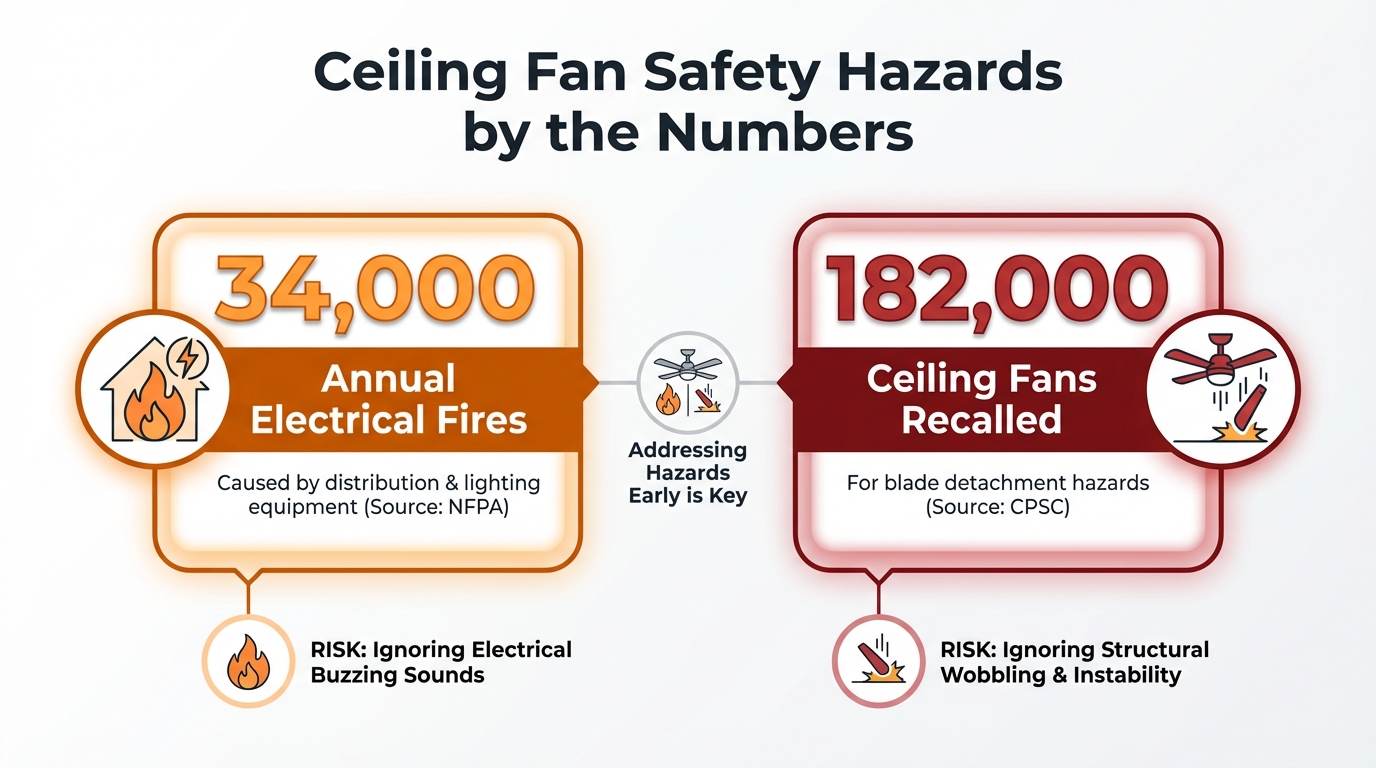
Most homeowners dismiss a wobbly or noisy ceiling fan as a minor inconvenience, something to deal with “eventually.” But behind that seemingly innocent wobble could lurk serious safety hazards that put your home and family at risk. According to the National Fire Protection Association, electrical distribution and lighting equipment—including ceiling fans—are involved in approximately 34,000 home structure fires annually in the United States, causing $1.5 billion in property damage. Meanwhile, the Electrical Safety Foundation International reports that 51,000 home electrical fires occur yearly, with arcing faults in loose ceiling fan connections being a primary ignition source.
Understanding when a ceiling fan problem is a simple DIY fix versus when it requires immediate professional intervention can mean the difference between a quick Saturday afternoon project and a devastating house fire. Some issues—like blade balancing—are perfectly safe for homeowners to tackle. Others—like electrical buzzing or severe wobbling—demand the expertise of a licensed electrician.
This guide will help Vancouver, WA and Portland, OR homeowners diagnose ceiling fan problems, perform safe fixes when appropriate, and recognize the critical warning signs that require calling Sarkinen Electrical. If your home was built before 1990, pay particularly close attention: many older homes in Clark County and Multnomah County have outdated electrical boxes that create hidden dangers lurking just above your ceiling.
Mechanical vs. Electrical Issues: Why the Difference Matters
Before you grab your screwdriver or pick up the phone, you need to understand a fundamental distinction: ceiling fan problems fall into two very different categories, and confusing them can be dangerous.
Mechanical instability typically stems from three sources. First, imbalanced blades caused by dust accumulation, warped blades due to Pacific Northwest humidity, or loose blade brackets. Second, mounting hardware failure from loose screws on the downrod or canopy. Third—and most dangerous—an improper electrical box. Many ceiling fans are mounted to standard light fixture boxes that were never designed to handle the rotational torque of a spinning fan. This isn’t just a performance issue; it’s a structural hazard waiting to happen.
Electrical warning signs require entirely different expertise. A buzzing or humming sound indicates incompatible dimmer switches or failing capacitors—both fire hazards. Flickering lights suggest loose wiring or arcing faults that create the conditions for electrical fires. These aren’t problems you can fix with a balancing kit and elbow grease.
Critical Safety Distinction:
While you can safely balance blades yourself, electrical problems involve energized circuits and code compliance. Getting it wrong doesn’t just mean a broken fan—it means risking your home and family.
The Consumer Product Safety Commission has recalled over 182,000 ceiling fans due to blade detachment and structural failures, underscoring just how serious these mechanical and electrical hazards can be.
Modern electrical codes exist for a reason. NEC Article 314.27(C) mandates fan-rated electrical boxes capable of supporting 70+ pounds and withstanding rotational vibration. If your home was built before these standards were implemented, there’s a significant chance your ceiling fan is mounted to an inadequate box—a code violation and a genuine safety risk.
Listen and Look: Reading Your Ceiling Fan’s Warning Signs
Your ceiling fan is constantly communicating its condition. You just need to know what to listen and look for.
The Wobble Assessment
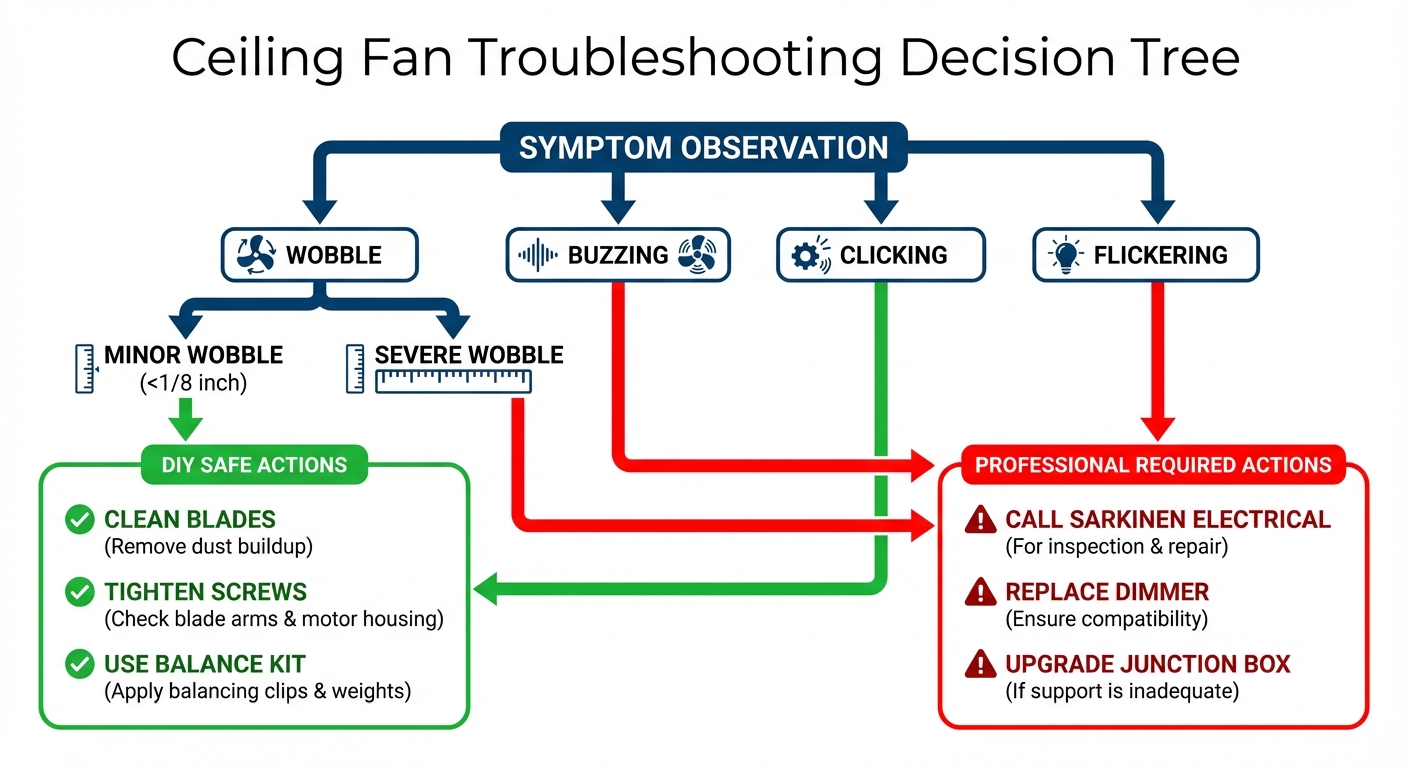
Start by measuring the wobble. Hold a ruler or yardstick against the ceiling and measure the distance between the ceiling and the highest point of the canopy as it rotates. Anything over 1/8 inch indicates a problem.
A minor wobble (less than 1/8 inch) typically signals blade imbalance—something you can fix yourself with a balancing kit. However, severe wobbling accompanied by visible canopy shaking is an entirely different beast. This suggests a structural or mounting issue that requires professional intervention immediately.
In older Portland and Vancouver homes, fans are often mounted to standard light fixture boxes never designed for the dynamic, rotational force of a spinning fan. This violates current electrical code and creates a very real collapse hazard. That vintage charming home in a historic neighborhood? It likely needs a mounting upgrade before it’s truly safe to operate a ceiling fan.
The Sound Diagnostic
Different sounds tell different stories:
Scraping or grinding indicates the canopy is rubbing against the ceiling or that motor bearings are failing. The former suggests improper installation; the latter means the motor’s internal components are wearing out.
Clicking or ticking usually points to loose blades or a pull chain tapping against the housing. These are typically simple mechanical fixes.
Buzzing or humming is the red flag that demands your immediate attention. This electrical sound almost always indicates one of two problems: an incompatible dimmer switch or a failing capacitor. Standard incandescent dimmers use phase-cutting technology that creates immense stress on fan motors, overheating windings and creating fire risks. If your fan buzzes when connected to a dimmer switch, turn it off immediately and contact a licensed electrician. This is not a “fix it later” situation.
Visual Warning Signs
What you see matters as much as what you hear:
Flickering fan lights indicate loose wiring or arcing—both require immediate professional inspection. Arcing creates intense heat at connection points and is a leading cause of electrical fires.
A hot motor housing signals electrical overload or a failing capacitor. Motors should run warm, not hot. If you can’t comfortably rest your hand on the motor housing, something is wrong.
Rust or corrosion on the canopy suggests moisture intrusion, particularly common in the Pacific Northwest’s damp climate. Moisture and electricity are a dangerous combination that compromises both safety and performance.
Homeowner-Safe Solutions: Balancing and Mechanical Adjustments
Now that you understand how to diagnose your fan’s problem, let’s walk through the fixes you can safely perform yourself.
Step 1: Power Down Safely
Before touching anything, turn off the fan at the wall switch. For added safety, flip the circuit breaker that controls the fan. Never work on a fan while it’s energized, even for mechanical adjustments. This simple precaution eliminates any risk of the fan accidentally turning on while you’re working on it.
Step 2: Clean and Inspect
Remove dust from all blades using a damp cloth. Dust accumulation shifts the fan’s center of gravity, and it’s particularly problematic during Vancouver and Portland’s dustier summer months. You’d be surprised how often a thorough cleaning eliminates a minor wobble.
Next, inspect each blade for warping. Hold a ruler against the blade edge to check for bowing. Wooden blades are especially susceptible to warping in the Pacific Northwest’s humid winter months.
Finally, check for loose blade brackets or mounting screws. Even a slightly loose screw can create wobble and noise.
Step 3: Systematic Tightening
Tighten all visible screws in this specific order:
- Blade-to-blade bracket screws
- Blade bracket-to-motor housing screws
- Motor housing-to-downrod screws
- Downrod-to-canopy screws
Important Tip:
Tighten until snug, but don’t over-torque. Excessive force can strip threads or crack plastic housings, creating worse problems than you started with. If a screw won’t tighten or continues to loosen, the threads may be stripped—that’s a sign you need professional repair or replacement.
Step 4: Blade Balancing
If cleaning and tightening haven’t eliminated the wobble, it’s time to use a balancing kit. Most quality ceiling fans include one, or you can purchase a kit inexpensively at any hardware store.
Here’s the process:
- Clip the balancing weight to the middle of one blade, positioning it on the blade’s leading edge
- Run the fan at medium speed and observe the wobble
- Move the clip to different blades, one at a time, until you identify which blade is causing the imbalance
- Once you’ve found the problematic blade, slide the clip along its length (toward the tip, then back toward the motor) to find the optimal position where the wobble is minimized
- When you’ve found the sweet spot, apply the permanent adhesive weight at that exact location
- Remove the balancing clip and test the fan again
Most ceiling fan wobbles can be eliminated with proper balancing. If the wobble persists after you’ve completed this process, the problem isn’t blade-related—it’s structural—and requires professional diagnosis.
When DIY Isn’t Enough
Stop your DIY efforts and call Sarkinen Electrical if:
- The wobble continues after proper balancing (this indicates an improper mounting box)
- You hear clicking from inside the motor housing (internal bearing failure requires professional repair or replacement)
- Any electrical symptoms appear (buzzing, humming, flickering lights, or hot motor housing)
- You discover rust, corrosion, or moisture inside the canopy
- The fan is installed in a home built before 1990 and you’ve never confirmed the electrical box is fan-rated
Electrical Red Flags: Safety Hazards That Require Professional Intervention
Some ceiling fan problems cross the line from inconvenient to dangerous. Here’s where homeowner intervention becomes both unsafe and illegal under current electrical codes.
The Incompatible Dimmer Hazard
One of the most common—and most dangerous—electrical mistakes homeowners make is connecting a ceiling fan to a standard light dimmer switch.
Here’s the technical reason this fails: dimmers reduce voltage by rapidly cutting the AC waveform. When you apply this interrupted power to a fan’s induction motor, it creates vibration, overheating, and potential motor coil failure. The motor essentially fights against the interrupted power, creating both excessive heat and that characteristic electrical buzz.
Consider this real scenario from a local Vancouver homeowner: they connected a modern ceiling fan to an existing incandescent dimmer to control fan speed. The fan immediately began buzzing loudly, and within hours, the motor casing became dangerously hot to the touch. A Sarkinen Electrical technician replaced the dimmer with a proper multi-capacitor fan speed control, eliminating the hazard and ensuring code compliance.
IMMEDIATE DANGER:
If your fan buzzes when controlled by a dimmer, you have an immediate fire hazard. Turn off the circuit breaker and contact us for emergency switch replacement. Do not simply ignore the buzzing—that sound is your warning that something is overheating.
Arcing and Flickering
Flickering fan lights indicate loose wire connections in the canopy or switch box. These loose connections create arcing faults—a leading cause of the 51,000 annual home electrical fires reported by safety authorities.
Arcing creates intense heat at connection points. You may hear crackling or see brief flashes inside the switch box. This requires immediate professional diagnosis. Attempting DIY electrical work on an arcing circuit is extremely dangerous. The arc can jump to conductive surfaces, creating shock hazards or igniting surrounding materials.
The Fan-Rated Box Requirement
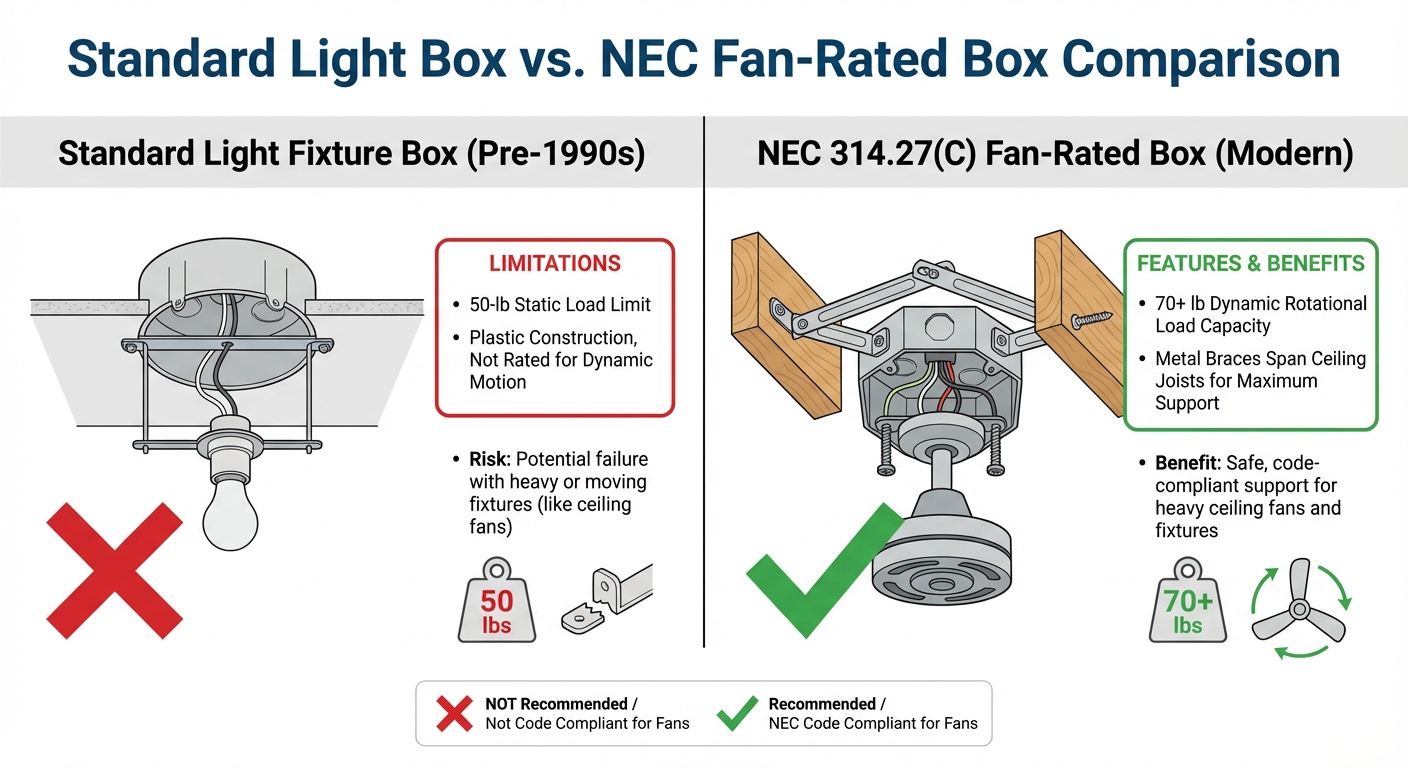
Here’s the historical context every homeowner needs to understand: pre-1990s homes often have standard plastic light fixture boxes rated for only static 50-pound loads. These boxes were designed to hold a chandelier that hangs motionless, not a ceiling fan that generates dynamic rotational force.
Modern NEC Article 314.27(C) mandates that outlet boxes used as the sole support of a ceiling-suspended paddle fan must be explicitly listed and marked as suitable for fan support. These fan-rated boxes are engineered to handle 70+ pounds and withstand rotational stress.
Many older homes in Vancouver, WA and Portland, OR—particularly in historic neighborhoods—have never had their electrical boxes upgraded. Installing or replacing a ceiling fan without a proper fan-rated box is both a code violation and a severe structural hazard.
CPSC reports document entire fan assemblies (40+ pounds) collapsing when mounted to non-rated boxes, causing property damage and serious injury risk. The box fractures under the constant vibration, and suddenly you have a heavy spinning object falling into your living space.
What Professional Service Includes
When you call Sarkinen Electrical for ceiling fan service, here’s what our licensed electricians provide:
- Comprehensive inspection of the existing electrical box and mounting hardware
- Installation of code-compliant, fan-rated junction boxes with proper ceiling joist bracing
- Verification of correct switch type (fan speed control versus incompatible dimmer)
- Testing for proper grounding and arc-fault protection
- Final inspection ensuring full NEC compliance
- Documentation for insurance purposes and future home sales
This isn’t just about fixing a wobble—it’s about ensuring your home meets current safety standards and protecting your family from preventable hazards.
Regional Factors: Why Pacific Northwest Homes Need Special Attention
Living in Vancouver, WA or Portland, OR means your ceiling fan faces unique challenges that homeowners in drier, newer regions don’t encounter.
Older Home Prevalence
Many homes in Clark County (WA) and Multnomah County (OR) were built in the 1950s through 1980s, before modern fan-rated box requirements existed. Historic neighborhoods throughout Portland and Vancouver feature charming older construction with outdated electrical infrastructure that looked perfectly adequate in 1975 but fails to meet current safety standards.
If your home was built before 1990 and you’re installing or replacing a ceiling fan, there’s a high probability your electrical box needs upgrading. This isn’t optional—it’s a safety requirement and a code compliance issue that could affect your homeowner’s insurance coverage.
Pacific Northwest Climate Challenges
Our coastal climate is beautiful, but it’s hard on ceiling fans. High humidity during winter months can warp wooden fan blades, creating the very imbalance issues we’ve discussed. Dust accumulation during dry summer months affects balance and creates buildup that shifts the fan’s center of gravity.
Moisture intrusion in poorly sealed canopies—common in older installations—causes rust and electrical corrosion. This is particularly problematic in bathrooms and covered outdoor spaces, where humidity levels are consistently elevated. Regular inspection and proper sealing are essential for longevity and safety in our damp environment.
Energy Efficiency Priorities
ENERGY STAR ceiling fans are increasingly popular in the energy-conscious Pacific Northwest, and for good reason: they use up to 60% less energy than conventional fans. However, proper installation is critical to maximizing this efficiency.
A wobbling or improperly wired fan can consume 30-40% more energy while providing less effective air circulation. The motor works harder to overcome mechanical resistance, drawing more current and generating excess heat. Professional installation ensures you actually receive the efficiency benefits you paid for.
Local Code Compliance
Both Washington and Oregon have adopted NEC standards with local amendments that vary by jurisdiction. Permit requirements for electrical work differ between Clark County, Vancouver city limits, Portland, and Multnomah County.
Sarkinen Electrical maintains current licensing in both Washington and Oregon, ensuring your ceiling fan installation meets all local code requirements and passes inspection. We handle the permitting process, coordinate inspections, and provide documentation that protects your home’s value and your insurance coverage.
Final Thoughts
Simple blade balancing? That’s a weekend DIY project you can tackle with confidence. Electrical buzzing, severe wobbling, or flickering lights? That’s a job for licensed professionals—no exceptions.
Your ceiling fan problem might seem minor, a small annoyance to deal with eventually. But it could indicate serious code violations or fire hazards lurking behind your ceiling. In the Pacific Northwest’s older homes, particularly those charming historic residences throughout Vancouver and Portland, the gap between how things were done decades ago and current safety standards can be dramatic.
The statistics paint a sobering picture: 34,000 electrical fires annually involving distribution equipment, 182,000+ fans recalled for mechanical failures, and 51,000 home electrical fires where arcing faults played a role. Ceiling fan safety isn’t optional or something to postpone.
Don’t let a wobbling fan become a falling fan. Don’t let a buzzing motor become a house fire.
If you’ve followed the DIY steps outlined above and the problem persists—or if you’ve identified any electrical warning signs—contact Sarkinen Electrical today for a professional ceiling fan inspection. Our licensed electricians serving Vancouver, WA and the greater Portland, OR area ensure your ceiling fans are safe, code-compliant, and built to last.
Need Expert Ceiling Fan Service?
Whether you need emergency repair for a hazardous electrical issue or want to upgrade to a modern, energy-efficient ceiling fan with proper mounting, we provide the expertise and service you deserve.
References:
- National Fire Protection Association (NFPA). (2022). Home Electrical Fires Report. https://www.nfpa.org/education-and-research/research/nfpa-research/fire-statistical-reports/electrical-fires
- Electrical Safety Foundation International (ESFI). (2023). Home Electrical Fires Statistics & Safety. https://www.esfi.org/home-electrical-fires/
- U.S. Consumer Product Safety Commission (CPSC). (2020). King of Fans Recalls Hampton Bay Mara Indoor/Outdoor Ceiling Fans Due to Injury Hazard. https://www.cpsc.gov/Recalls/2021/King-of-Fans-Recalls-Hampton-Bay-Mara-Indoor-Outdoor-Ceiling-Fans-Due-to-Injury-Hazard-Sold-Exclusively-at-Home-Depot
- ENERGY STAR. (2024). Ceiling Fans: Energy Efficiency and Motor Guidelines. https://www.energystar.gov/products/lighting_fans/ceiling_fans
- National Fire Protection Association (NFPA). (2023). NFPA 70: National Electrical Code (NEC) – Article 314.27(C). https://www.nfpa.org/codes-and-standards/all-codes-and-standards/list-of-codes-and-standards/detail?code=70