
Table of Contents
- Decoding the Chirp: What Your Smoke Detector Is Trying to Tell You
- Troubleshooting 101: How to Stop the Chirping (Temporarily)
- Why Battery-Operated Alarms Are a Silent Risk to Your Family
- When One Sounds, They All Sound: How Interconnected Systems Save Lives
- Professional Installation You Can Trust: Sarkinen Electrical’s Hardwired Smoke Alarm Services
- Final Thoughts
We’ve all been there—it’s 2:00 AM, and that relentless, high-pitched chirp echoes through your house. You stumble out of bed, bleary-eyed, trying to locate which smoke detector has decided to betray your need for sleep. While the late-night chirping is undeniably frustrating, it’s actually a critical diagnostic signal from life-safety equipment designed to protect you and your family.
In this comprehensive guide, Sarkinen Electrical breaks down why smoke detectors chirp, what those chirps mean, and—most importantly—how upgrading to a hardwired, interconnected smoke alarm system can eliminate nuisance chirping while dramatically improving your home’s fire safety.
According to the National Fire Protection Association (NFPA), the risk of dying in a home fire is 55% lower in homes with working smoke alarms. Yet, in 43% of home fires where alarms were present but failed to operate, the devices had missing or disconnected batteries—often removed by frustrated homeowners trying to silence false alarms.
Whether you’re in Vancouver, WA, or Portland, OR, understanding the science behind smoke detector diagnostics and the lifesaving advantages of professionally installed hardwired systems could be the difference between a good night’s sleep and a preventable tragedy.
Decoding the Chirp: What Your Smoke Detector Is Trying to Tell You
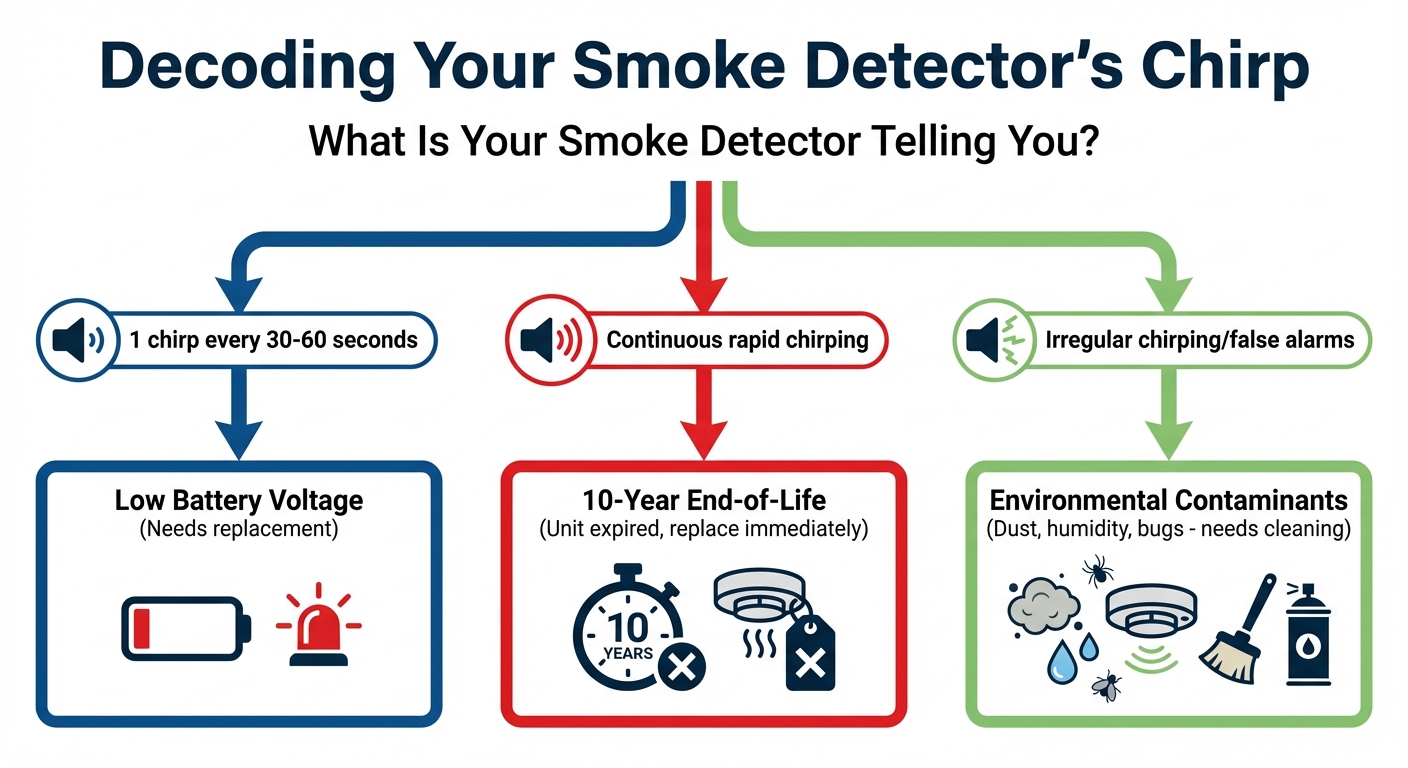
Before you rip the batteries out in frustration, it’s essential to understand that chirping isn’t random—it’s a precise diagnostic signal indicating specific issues with your smoke alarm’s functionality.
Low Battery Voltage
Most smoke alarms require a steady voltage (typically 9 volts) to power internal circuitry. When a battery drops below approximately 7.5–8 volts, an internal microprocessor triggers a brief, high-pitched chirp every 30–60 seconds. Temperature drops—especially overnight—can cause voltage to dip, which is why detectors frequently begin chirping at 2:00 AM.
This phenomenon isn’t a design flaw; it’s an intentional safety feature. The chirp serves as an early warning system, alerting you that the detector’s power source is degrading before it fails completely. The temperature-sensitive nature of battery chemistry means that as your home cools during the night, the chemical reactions within the battery slow down, temporarily reducing voltage output and triggering the low-battery warning.
The 10-Year End-of-Life Warning
Smoke detectors don’t last forever. Both the U.S. Fire Administration (USFA) and NFPA mandate a 10-year maximum lifespan for all smoke alarms. Modern detectors feature an “End-of-Life” (EOL) timer that triggers a distinct, continuous chirping pattern when the device reaches 10 years old, signaling mandatory replacement—not just a battery issue.
Ionization alarms use a tiny amount of radioactive material (Americium-241) to ionize air; over time, sensor degradation reduces sensitivity. Photoelectric alarms rely on an internal light source and sensor, which degrade and become prone to false readings over a decade.
This built-in obsolescence isn’t planned; it’s based on rigorous testing showing that sensor reliability decreases significantly after ten years of continuous operation. The components simply wear out, and no amount of battery replacement or cleaning can restore them to their original sensitivity.
Environmental Contaminants
In the Pacific Northwest (Portland/Vancouver), high humidity, seasonal dust, pet dander, and even microscopic insects can infiltrate the sensing chamber. Dust particles can scatter the light beam in photoelectric alarms or disrupt the electrical current in ionization models, triggering false chirps.
Our regional climate creates unique challenges for smoke detector maintenance. The combination of wet winters and dry summers causes expansion and contraction within the detector housing, potentially allowing contaminants to enter the sensing chamber. Additionally, homes near construction sites or agricultural areas may experience higher levels of airborne particulates that accumulate inside detectors over time.
Troubleshooting 101: How to Stop the Chirping (Temporarily)
Before calling a professional, homeowners can perform a few simple diagnostic checks to determine if the chirp can be resolved with basic maintenance.
Step 1: Replace the Battery
If your detector uses a replaceable 9-volt or AA battery, swap it out with a fresh one. Always use name-brand batteries (Duracell, Energizer) rather than generic brands, as voltage consistency matters for sensor reliability.
Generic batteries may have inconsistent voltage curves, meaning they might start strong but degrade rapidly, leading to premature low-battery warnings. Quality batteries provide more stable voltage throughout their lifespan, reducing nuisance chirping and ensuring your detector maintains optimal sensitivity.
Step 2: Check the Manufacturing Date
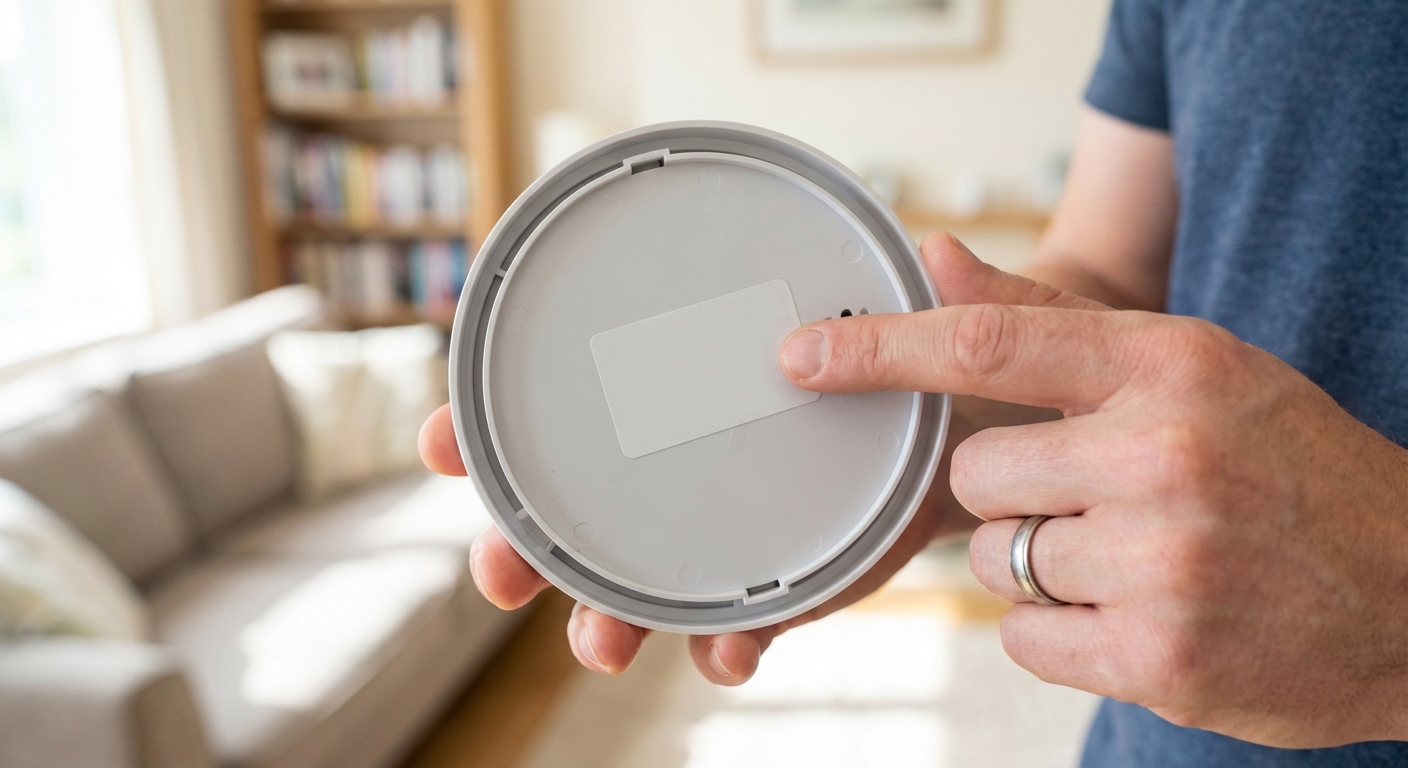
Open the detector and look for a manufacturing or “replace by” date stamped on the back. If the unit is 10+ years old, replacement is non-negotiable. Even with a fresh battery, an expired detector is a life-safety liability.
The date is typically printed directly on the back of the detector housing, often near the mounting bracket. It may be labeled as “Manufactured,” “MFG Date,” “Install Date,” or “Replace By.” If you can’t find this information, or if the detector predates the practice of date-stamping (roughly pre-2000), it’s time for an immediate replacement.
Step 3: Vacuum the Sensing Chamber
Use a soft brush attachment on your vacuum to gently clear dust, cobwebs, and debris from the exterior vents. For photoelectric models, compressed air (like canned keyboard cleaner) can dislodge internal particles. Never use water or cleaning chemicals, as moisture can permanently damage the sensor.
When using compressed air, hold the can upright and use short bursts rather than continuous spraying. This prevents liquid propellant from entering the chamber. Work from multiple angles, ensuring you address all the ventilation slots around the detector’s perimeter.
Step 4: Test the Detector
After replacing the battery or cleaning, press and hold the “test” button for 3–5 seconds. You should hear a loud, sustained alarm. If the alarm is weak or non-existent, the unit has failed and must be replaced.
A properly functioning alarm should produce a sound level of at least 85 decibels measured from 10 feet away—roughly equivalent to the noise level of a garbage disposal. If you need to strain to hear the alarm, or if it sounds muffled or intermittent, the unit’s speaker or internal circuitry has degraded beyond repair.
⚠️ When DIY Isn’t Enough
If chirping persists after battery replacement, the unit is past 10 years old, or the alarm fails the test button check, it’s time to upgrade to a professionally installed hardwired system. These temporary fixes address symptoms, but they don’t resolve the underlying vulnerability of battery-operated alarms.
Why Battery-Operated Alarms Are a Silent Risk to Your Family
While battery-operated smoke detectors meet minimum legal requirements in older homes, they come with critical vulnerabilities that can fail during the moments you need them most.
The Disabled Alarm Epidemic
The NFPA found that in 43% of home fires where smoke alarms were present but failed to operate, the devices had missing or disconnected batteries—often removed by frustrated homeowners trying to silence nuisance chirping. This single statistic reveals a chilling truth: the very feature designed to keep detectors functional (the low-battery chirp) is causing people to disable their life-safety equipment.
Think about it—when a smoke detector chirps at 2:00 AM, the immediate impulse is to make it stop. Many homeowners remove the battery with the intention of replacing it “tomorrow,” but life gets busy, days turn into weeks, and the detector remains non-functional. During this window of vulnerability, a fire could occur with devastating consequences.
Lack of Interconnectivity = Delayed Response
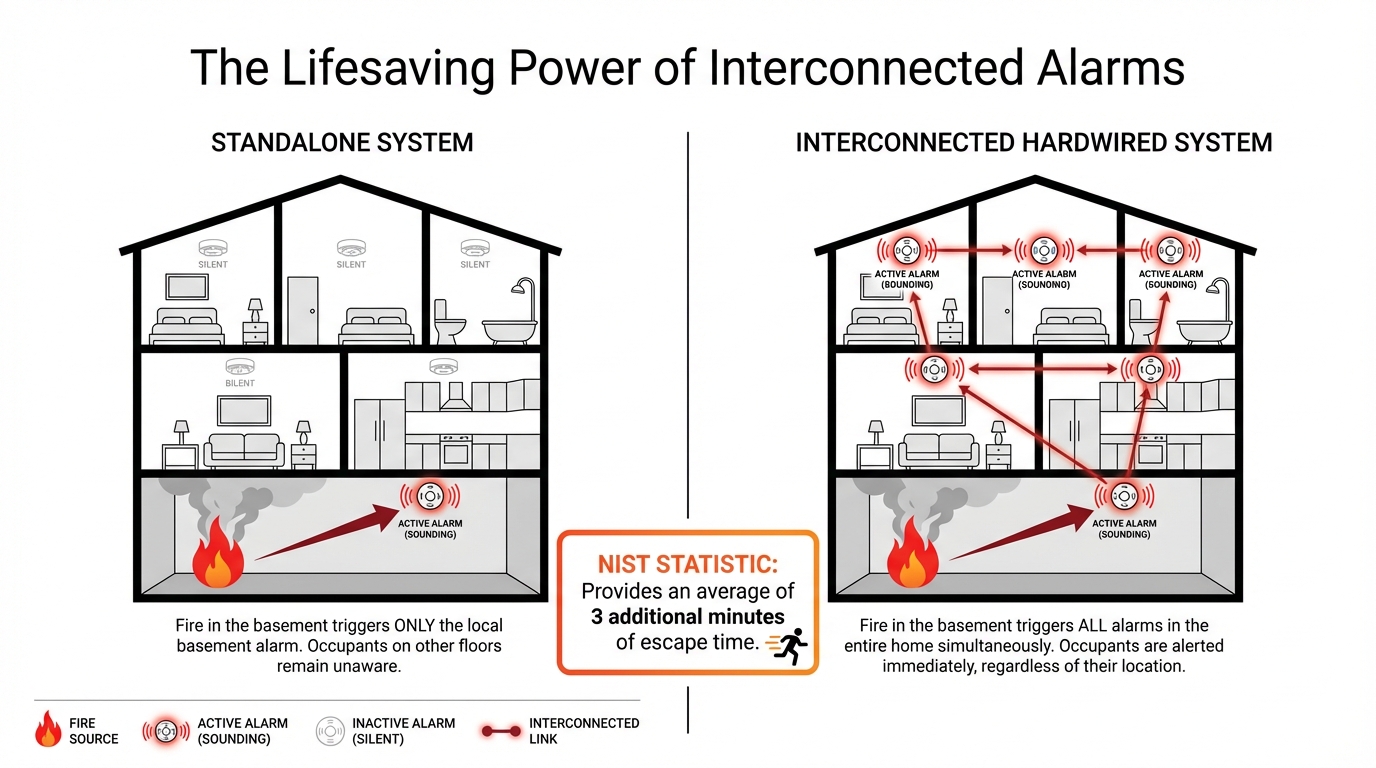
Standalone battery alarms sound only in the room where smoke is detected. If a fire starts in your basement or garage while you’re asleep on the second floor, a single-unit alarm may not wake you in time. According to a landmark study by the National Institute of Standards and Technology (NIST), homes with interconnected hardwired smoke alarms provided occupants with an average of 3 additional minutes of escape time compared to standalone units—a critical window that drastically increased survival rates.
Three minutes may not sound like much, but in a residential fire, it’s the difference between a successful evacuation and a tragedy. Modern home furnishings—synthetic fabrics, foam cushions, and particle board furniture—burn faster and produce more toxic smoke than the natural materials common in homes built before 1980. This means fires develop more rapidly, and those extra minutes of warning time are literally life-saving.
Annual Maintenance Burden
Battery-only alarms require annual battery replacements, manual testing, and regular cleaning. In the chaos of daily life, these tasks are frequently forgotten, leaving families vulnerable. Nearly three out of five (59%) home fire deaths occur in properties with no smoke alarms (41%) or smoke alarms that failed to operate (16%).
Consider the typical household maintenance schedule: HVAC filters need changing, gutters need cleaning, water heaters need flushing, and smoke detector batteries need replacing. It’s easy for this last item to slip through the cracks, especially when the detector seems to be working fine. Unfortunately, by the time you discover the battery is dead, it may be too late.
Building Code Non-Compliance
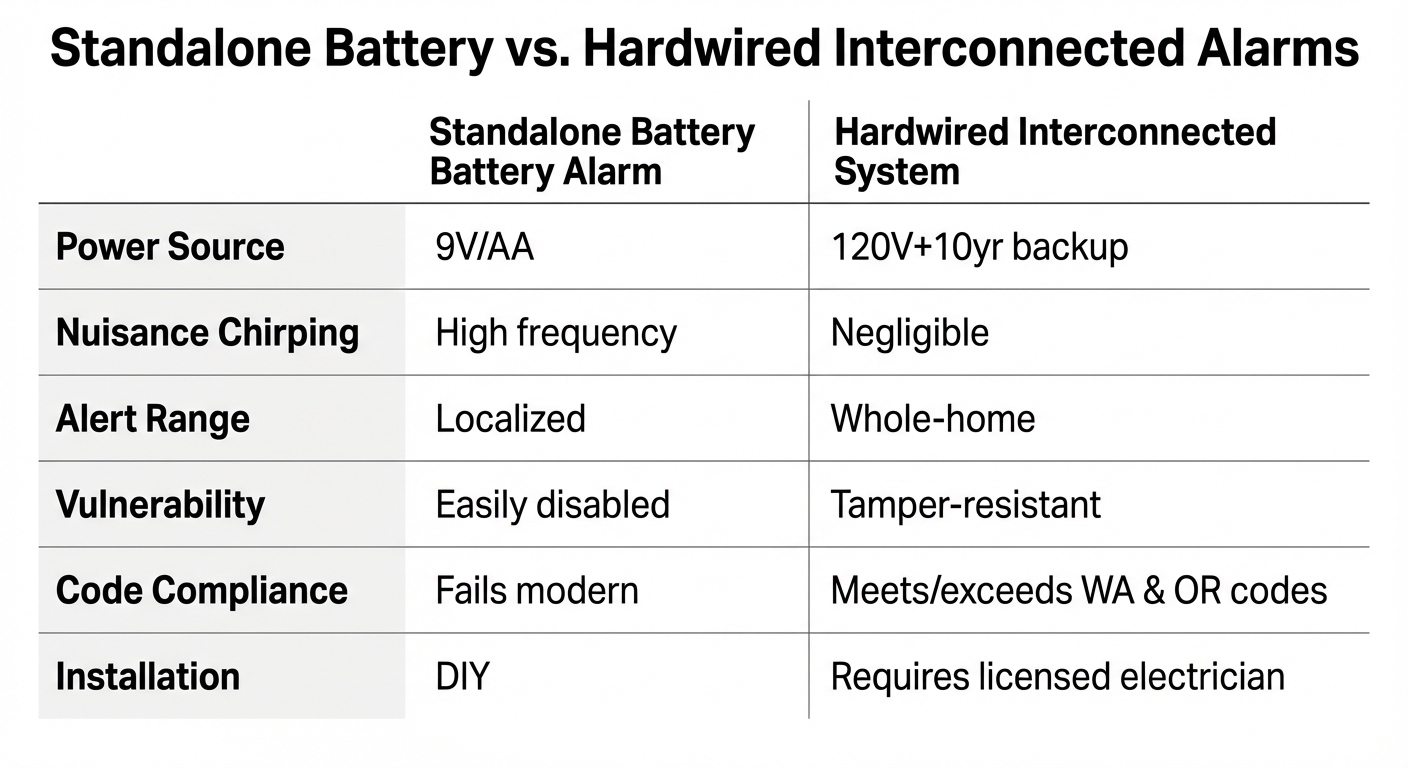
Both the Washington State Building Code (WAC 51-51) and the Oregon Residential Specialty Code (ORSC) mandate that in new construction and significant remodels, smoke alarms must receive primary power from building wiring and be interconnected. If you’re planning a home remodel or addition, relying on battery-only units may put you out of compliance with local building codes.
This isn’t arbitrary red tape—these codes were adopted in response to decades of fire safety data showing the superior performance of hardwired systems. If you’re applying for permits for any major renovation, building inspectors will verify that your smoke detection system meets current standards, and outdated battery-operated units won’t pass inspection.
When One Sounds, They All Sound: How Interconnected Systems Save Lives
The most critical distinction between standalone and hardwired smoke alarm systems is interconnectivity—a feature that building codes now require because it has been proven to provide lifesaving early warnings.
Whole-Home Alert Coverage
Hardwired interconnected systems are wired into your home’s electrical circuit, allowing all detectors to communicate. If a detector in the garage senses smoke, every alarm in the house sounds simultaneously—alerting occupants in bedrooms on the opposite side of the home. This is especially critical during nighttime fires when escape windows are measured in minutes, not hours.
Consider a typical scenario: a fire starts in the garage due to an electrical malfunction in a power tool left plugged in overnight. With standalone alarms, the garage detector sounds, but family members sleeping in second-floor bedrooms remain unaware until smoke travels through the house—potentially blocking escape routes. With interconnected alarms, everyone is alerted simultaneously, providing maximum time to evacuate safely.
Code-Mandated for a Reason
Modern residential building codes in Washington and Oregon require interconnected alarms in new construction because of their proven effectiveness. The Washington State Building Code (WAC 51-51) and Oregon Residential Specialty Code (ORSC) both stipulate that smoke alarms must receive primary power from building wiring and be interconnected. If you’re renovating or building an addition, upgrading your entire home’s smoke detection system to hardwired interconnected units ensures compliance and maximizes safety.
These requirements extend beyond new construction. If you’re adding square footage, converting a basement or attic, or making structural modifications that require permits, inspectors will likely require your smoke detection system to be brought up to current code throughout the entire dwelling—not just in the renovated areas.
No More Midnight Battery Swaps
Hardwired systems are powered by your home’s 120-volt electrical system and equipped with a sealed 10-year lithium battery backup. This eliminates the annual battery replacement burden and drastically reduces nuisance chirping. The backup battery ensures functionality during power outages without requiring homeowner intervention.
The sealed battery technology represents a significant advancement in smoke detector design. Unlike replaceable 9-volt batteries that degrade over time and require periodic swapping, sealed lithium batteries maintain consistent voltage for the entire 10-year lifespan of the detector. When the detector reaches its end-of-life date, you replace the entire unit—battery, sensors, and all—ensuring optimal performance.
Professional Installation by Licensed Electricians
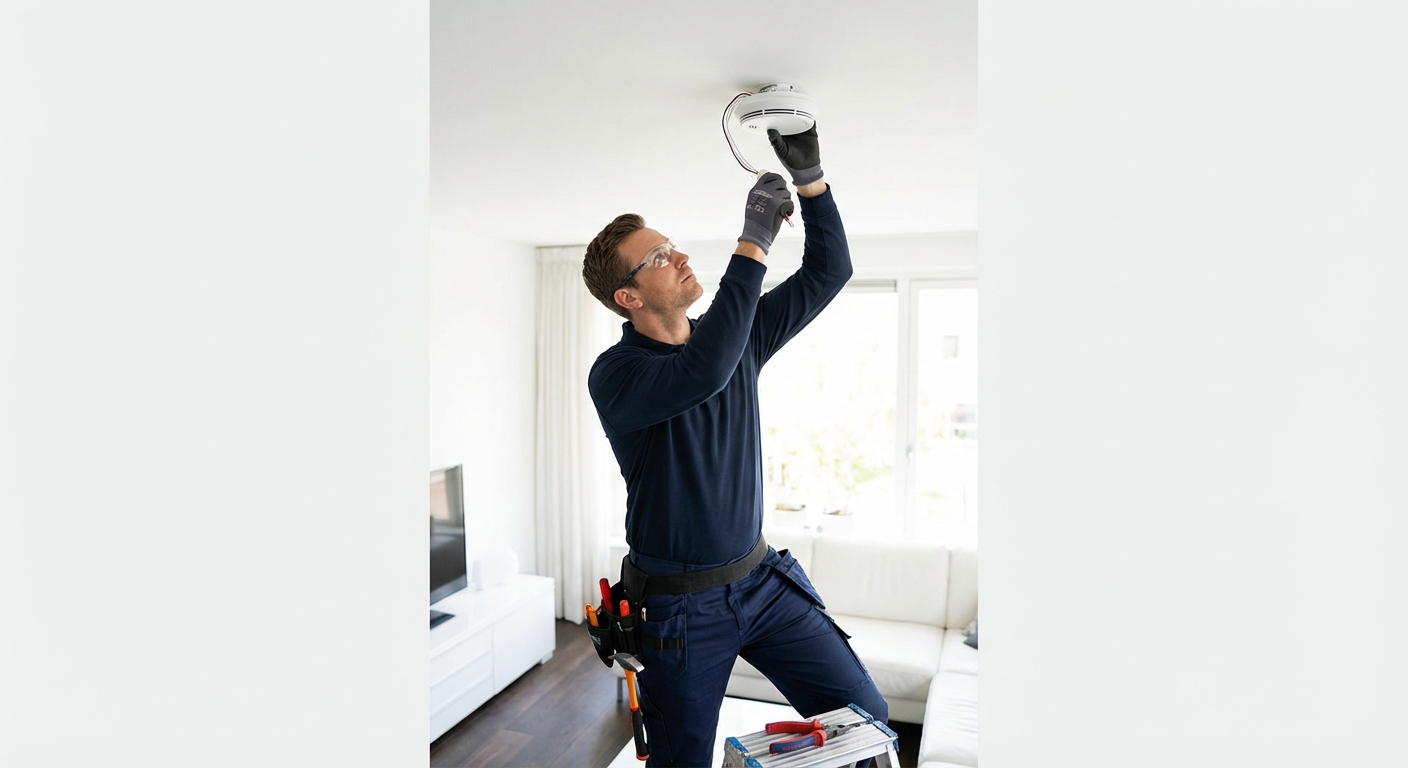
Unlike battery-operated units that can be mounted with a screwdriver, hardwired systems require professional installation by licensed electricians like Sarkinen Electrical. Our team ensures proper wiring, code compliance, optimal detector placement (bedrooms, hallways, basements, and living areas), and thorough system testing.
Professional installation isn’t just about connecting wires—it involves understanding fire behavior, building layouts, and electrical load calculations. Proper placement accounts for air flow patterns, door swing directions, ceiling height, and potential sources of false alarms. An experienced electrician knows, for example, that detectors should be placed at least 10 feet from cooking appliances to prevent nuisance alarms, but close enough to hallways and sleeping areas to provide early warning.
Professional Installation You Can Trust: Sarkinen Electrical’s Hardwired Smoke Alarm Services
Upgrading to a hardwired interconnected smoke detection system is not a DIY project—it requires the expertise of a licensed electrician who understands local building codes, optimal detector placement, and proper electrical integration.
Licensed & Experienced
Sarkinen Electrical is a fully licensed electrical contractor serving Vancouver, WA, and Portland, OR. Our team has decades of combined experience in residential electrical safety upgrades, ensuring your home meets or exceeds Washington and Oregon building codes.
Our electricians maintain active continuing education in fire safety systems, staying current with evolving technology and code requirements. We understand the unique challenges of Pacific Northwest homes, from older construction with knob-and-tube wiring to modern smart home integrations.
Code Compliance Expertise
We stay current with evolving WAC 51-51 and ORSC requirements, ensuring that your smoke alarm installation is compliant with state and local regulations. Whether you’re completing a remodel, building an addition, or simply upgrading for safety, we handle permitting and inspections.
Code compliance isn’t just about passing inspection—it’s about ensuring your insurance coverage remains valid and your home’s resale value is protected. Non-compliant electrical work can create liability issues if a fire occurs, and many homeowners are surprised to learn that their insurance policies may deny claims if the property wasn’t maintained to current safety standards.
Strategic Detector Placement
Proper smoke alarm placement is critical. Detectors must be installed:
- Inside every bedroom
- Outside each sleeping area (hallways)
- On every level of the home, including basements
- Near kitchens (but not so close that cooking triggers false alarms)
Our electricians assess your home’s layout and ensure optimal coverage. We consider factors like ceiling height (detectors should be mounted high, as smoke rises), air flow patterns (avoiding placement near HVAC vents that could blow smoke away from sensors), and potential sources of false alarms (steam from bathrooms, cooking fumes from kitchens).
Comprehensive System Testing
After installation, we test every detector individually and verify interconnectivity across the entire system. You’ll receive a walkthrough of how the system operates, how to test it monthly, and what to expect from the 10-year sealed battery backups.
We document the installation with photographs and detailed records showing manufacturing dates, model numbers, and installation locations. This documentation becomes part of your home’s maintenance records and can be invaluable for future renovations or insurance claims.
Seamless Integration with Existing Electrical
Our team ensures that hardwired smoke alarms are integrated cleanly into your home’s existing electrical system without unsightly surface-mounted conduit or code violations. We work with your home’s aesthetic, running wiring through walls and attics to maintain a clean, professional appearance.
For older homes, this may involve creative routing solutions to avoid disturbing finished surfaces. Our experience with vintage Portland and Vancouver homes means we understand how to work with plaster walls, limited attic access, and existing electrical systems while maintaining structural integrity.
Ready to Upgrade Your Home’s Safety?
Don’t wait for a chirping alarm to turn into a life-threatening emergency. Contact Sarkinen Electrical today for a free consultation on upgrading your home’s smoke detection system to a hardwired interconnected solution that provides superior safety, code compliance, and peace of mind.
Final Thoughts
That persistent 2:00 AM chirp isn’t just an annoyance—it’s your smoke detector’s way of telling you it’s time for an upgrade. While replacing a battery or vacuuming dust may provide temporary relief, the only long-term solution that maximizes your family’s safety is a professionally installed hardwired interconnected smoke alarm system.
The statistics are undeniable: working smoke alarms reduce the risk of dying in a home fire by 55%, but only if they remain functional. Battery-operated alarms are too easily disabled, lack whole-home coverage, and fail to meet modern building codes. Hardwired systems eliminate nuisance chirping, provide simultaneous alerts throughout your home, and offer the peace of mind that comes with code-compliant, professionally installed life-safety equipment.
As your trusted electrical partner in Vancouver, WA, and Portland, OR, Sarkinen Electrical is here to assess your home’s current smoke detection system, recommend code-compliant upgrades, and ensure your family is protected by the most reliable technology available.
Don’t let a chirping alarm become a tragic statistic. Contact Sarkinen Electrical today and invest in a safer home. Learn more about our smoke detector installation services.
References:
- Ahrens, M. (2021). Smoke Alarms in U.S. Home Fires. National Fire Protection Association (NFPA). https://www.nfpa.org/education-and-research/research/nfpa-research/fire-statistical-reports/smoke-alarms-in-us-home-fires
- Bukowski, R. W., et al. (2007). Performance of Home Smoke Alarms Analysis of the Response of Several Available Technologies in Residential Fire Settings. National Institute of Standards and Technology (NIST). https://www.nist.gov/publications/performance-home-smoke-alarms-analysis-response-several-available-technologies
- Electrical Safety Foundation International (ESFI). (2023). Smoke Alarm Safety Tips. https://www.esfi.org/smoke-alarm-safety-tips/
- National Fire Protection Association (NFPA). (2023). Ionization vs. Photoelectric Smoke Alarms. https://www.nfpa.org/Public-Education/Fire-causes-and-risks/Top-fire-causes/Smoke-alarms/Ionization-vs-photoelectric
- Oregon Building Codes Division. (2023). Oregon Residential Specialty Code (ORSC). https://www.oregon.gov/bcd/codes-stand/Pages/residential-structures.aspx
- U.S. Consumer Product Safety Commission (CPSC). (2023). Smoke Alarms – Why, Where, and Which. https://www.cpsc.gov/Safety-Education/Safety-Education-Centers/Fire-Safety-Information-Center/Smoke-Alarms
- U.S. Fire Administration (USFA). (2022). Smoke Alarm Outreach Materials. https://www.usfa.fema.gov/prevention/home-fires/prepare-for-fire/smoke-alarms/
- Washington State Building Code Council. (2021). Washington State Residential Code (WAC 51-51) Section R314 – Smoke Alarms. https://app.leg.wa.gov/wac/default.aspx?cite=51-51