
Table of Contents
- The Life-Saving Technology Behind Your Bathroom Outlets
- From Optional to Essential: The Evolution of GFCI Code Requirements
- Decoding Your Home’s Electrical Protection: Three Types of Outlets Explained
- Understanding Nuisance Trips vs. Legitimate Safety Responses
- A Homeowner’s Step-by-Step Guide to Safely Diagnosing Dead Outlets
- Key Takeaways
Have you ever plugged in your hairdryer in the bathroom, only to have the outlet suddenly go dead? Or noticed that your kitchen countertop outlets occasionally lose power for no apparent reason? If so, you’ve likely encountered a Ground Fault Circuit Interrupter (GFCI) doing exactly what it’s designed to do—protecting you from a potentially deadly electrical shock.
For homeowners in the Pacific Northwest, particularly in Vancouver, WA and Portland, OR, where high humidity and frequent rain are the norm, GFCI outlets are even more critical. The ambient moisture in our region can increase the likelihood of electrical faults, making these safety devices work overtime to keep your family safe.
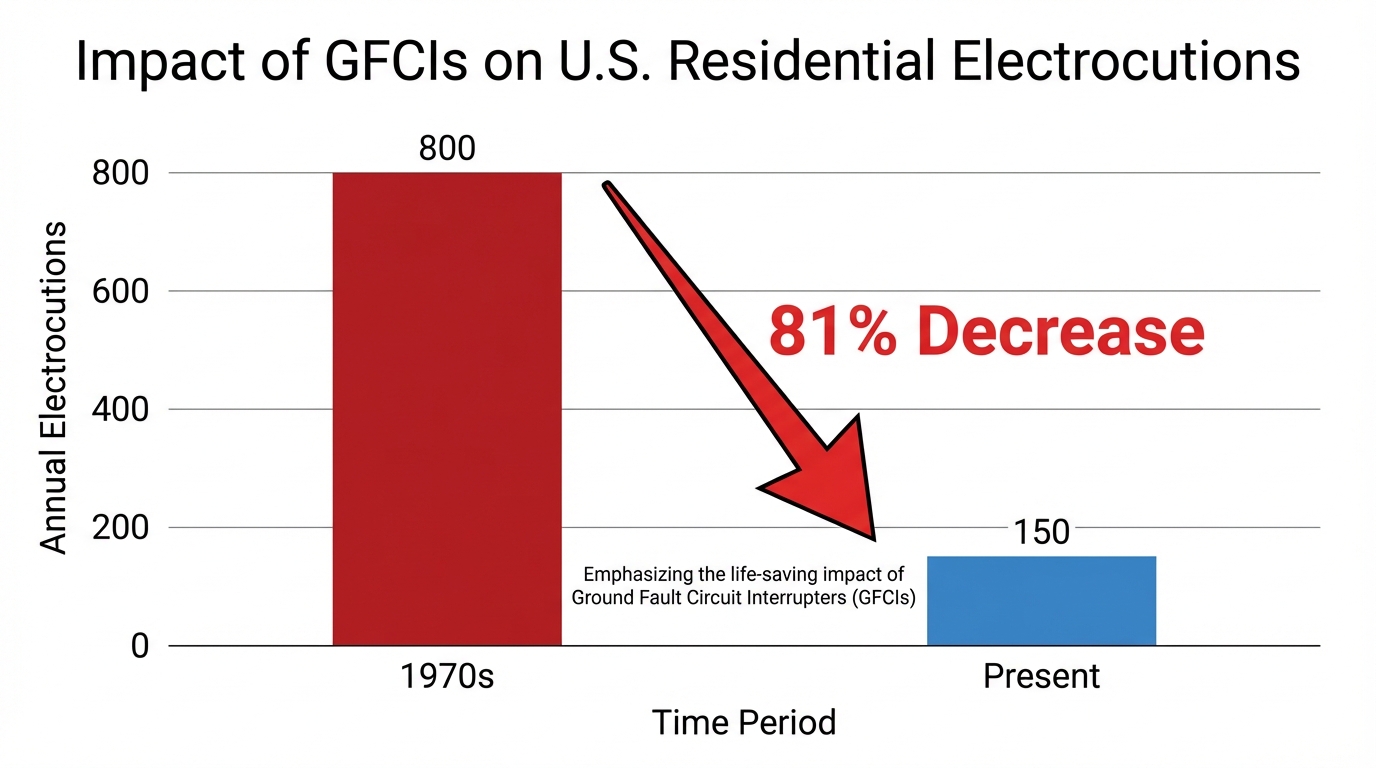
Since their introduction in the 1970s, GFCIs have reduced residential electrocutions by an astounding 81%, saving countless lives. Yet many homeowners don’t fully understand how these devices work, when they should trip, or what to do when an outlet goes dead. This guide will walk you through everything you need to know about GFCI outlets in wet rooms—from the science behind how they work to safe troubleshooting steps you can take before calling a professional electrician.
The Life-Saving Technology Behind Your Bathroom Outlets
Understanding the fundamental purpose and mechanism of GFCI outlets establishes why they’re legally required in wet locations and how they differ from standard outlets.
What Makes a GFCI Different?
A GFCI is fundamentally different from a standard circuit breaker—while breakers protect your home’s wiring from overheating, GFCIs protect you from electrical shock. This distinction is crucial for understanding why these outlets are mandatory in areas where water and electricity might come into contact.
The Science of Protection
These remarkable devices constantly monitor electrical current flowing through the hot wire and returning through the neutral wire. Under normal conditions, these currents should be exactly equal. If even 4-6 milliamperes of current “leaks”—such as through a person’s body touching both a live wire and a grounded surface—the GFCI detects this imbalance and cuts power in just 1/40th of a second. That’s faster than a potentially lethal shock can occur.
To put this in perspective, it takes only about 10-20 milliamperes of current to cause a sustained muscular contraction that prevents a person from releasing their grip on an electrical conductor. The GFCI’s 4-6 milliampere threshold means it interrupts the circuit well before you’d experience this dangerous “can’t let go” phenomenon.
A Proven Track Record
The implementation of GFCIs has been one of the most successful electrical safety initiatives in U.S. history. Annual residential electrocutions have dropped from over 800 in the early 1970s to fewer than 150 today—a direct result of widespread GFCI adoption. This 81% reduction represents thousands of lives saved and countless injuries prevented over the past five decades.
Why the Pacific Northwest Needs Extra Vigilance
In our damp climate, the risk of moisture-related electrical faults is higher than in drier regions. Old homes built before the 1980s often lack adequate GFCI protection unless they’ve been retrofitted to meet current safety standards. The combination of rainy weather, high indoor humidity, and older electrical systems creates a perfect storm for ground fault conditions—making GFCI protection absolutely essential for Pacific Northwest homes.
From Optional to Essential: The Evolution of GFCI Code Requirements
The National Electrical Code has progressively expanded GFCI requirements over five decades as the technology proved its effectiveness in preventing electrical injuries and fatalities.
A Timeline of Expanding Protection
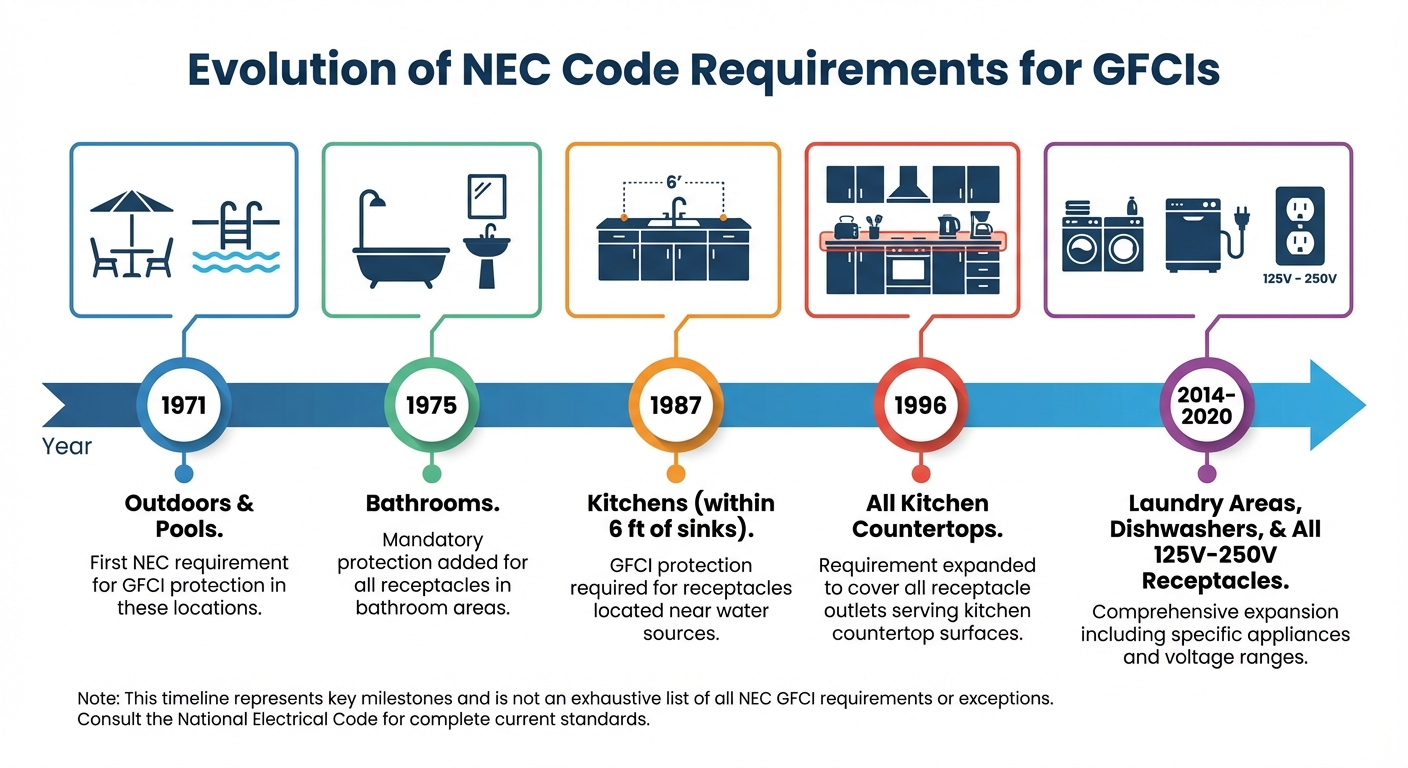
GFCI requirements began modestly in 1971 with outdoor outlets and pool equipment, then expanded systematically as data demonstrated their effectiveness:
- 1971: Outdoor receptacles and swimming pool equipment
- 1975: All bathroom receptacles
- 1987: Kitchen receptacles within 6 feet of sinks
- 1996: All kitchen countertop receptacles
- 2014-2020: Laundry areas, dishwashers, and all 125-250 volt receptacles
Today’s Comprehensive Requirements
Current code mandates GFCI protection in bathrooms, kitchens, garages, unfinished basements, crawl spaces, laundry areas, and all outdoor locations. These requirements recognize that any area where water and electricity might interact poses a potential shock hazard.
What This Means for Local Homeowners
If your Vancouver or Portland area home was built before 1996, it may not have adequate GFCI protection in all required locations. This isn’t just an academic concern—it’s a real safety issue. Municipal building departments heavily enforce NEC updates during remodeling projects, particularly given our region’s moisture challenges.
When older homes undergo kitchen or bathroom renovations, bringing electrical systems up to current code isn’t optional—it’s mandatory. While this might seem like an unnecessary expense, it’s actually an investment in your family’s safety. The good news is that retrofitting GFCI protection is relatively straightforward for licensed electricians and can often be accomplished without major rewiring.
Pacific Northwest Enforcement Standards
Local municipalities in the Vancouver, WA and Portland, OR metro areas strictly enforce current NEC standards during renovations. This heightened enforcement recognizes our coastal and river-valley moisture levels, which increase the risk of electrical faults. Building inspectors are particularly attentive to GFCI compliance in wet areas, understanding that our climate makes these protections even more critical than in drier regions.
Decoding Your Home’s Electrical Protection: Three Types of Outlets Explained
Many homeowners confuse different types of electrical protection devices. Understanding the distinctions helps you identify which outlets serve which purpose and why they’re located where they are.
Standard Outlets: Basic Power Delivery
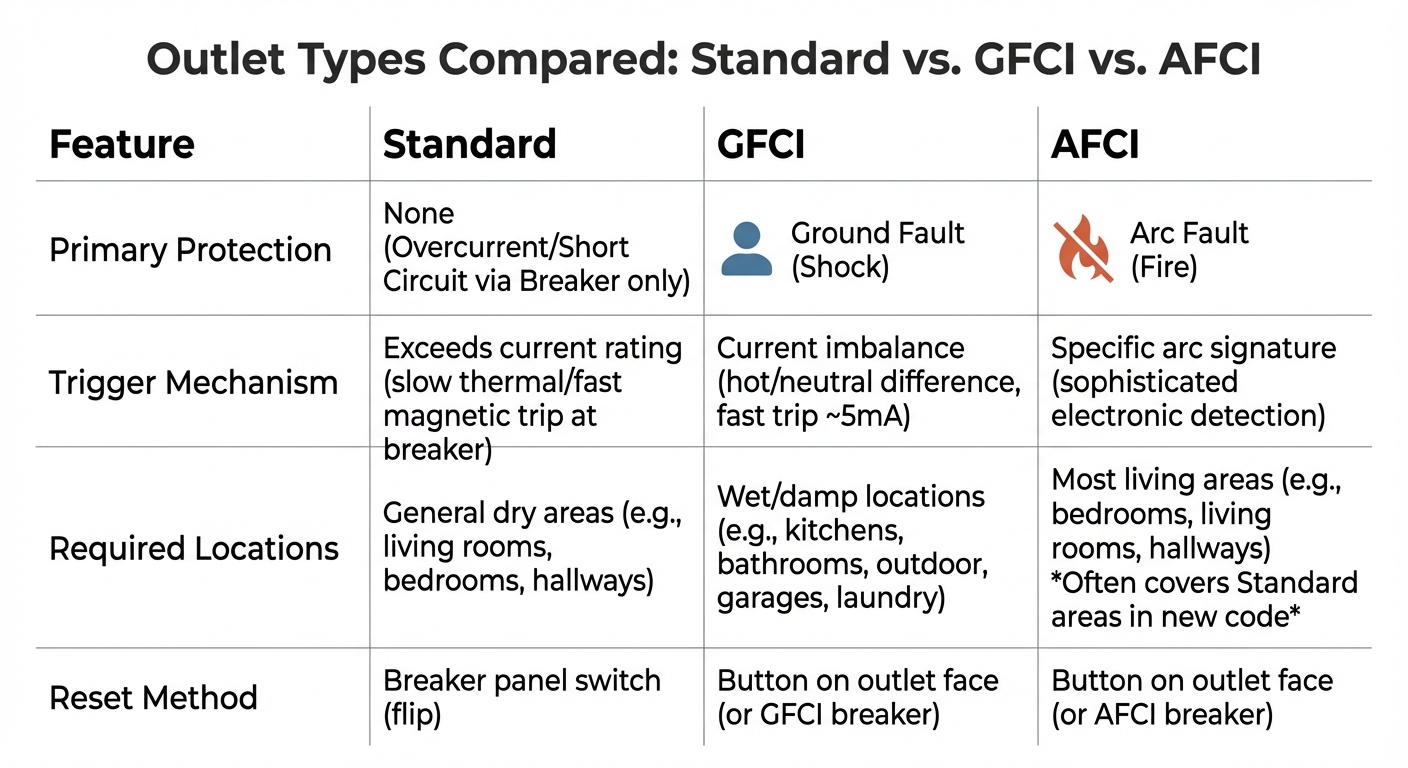
Standard outlets provide no inherent protection beyond what’s offered by the circuit breaker in your main panel. These breakers prevent overloads and short circuits but won’t protect you from ground faults or shock hazards. In older homes, standard outlets might be found throughout the house. In newer construction, they’re primarily limited to dry living areas where water exposure is unlikely.
GFCI Outlets: People Protection
GFCI outlets are designed to protect people by detecting current leakage and preventing shock. Required in wet locations where water and electricity may interact, these outlets feature distinctive “TEST” and “RESET” buttons on their face. When functioning properly, they’ll cut power in milliseconds if they detect even a tiny current imbalance.
AFCI Outlets: Property Protection
Arc Fault Circuit Interrupter (AFCI) outlets are designed to protect property by detecting dangerous electrical arcs that can start fires. Required primarily in bedrooms, living rooms, and hallways, AFCIs prevent a different type of hazard than GFCIs. They detect the unique electrical signature of arcing faults—the kind that can occur when wiring insulation deteriorates or connections loosen.
Understanding Trigger Thresholds
The key difference between these protection devices lies in what triggers them:
- Standard breakers trip when too much current flows through the circuit (typically 15-20 amps)
- GFCIs trip on as little as 4-6mA of current imbalance—an amount too small to trip a standard breaker but enough to be dangerous to humans
- AFCIs detect the unique electrical signature of arcing faults, which have a distinctive pattern different from normal electrical flow
Visual Identification Made Easy
You can easily identify GFCI outlets by their TEST and RESET buttons prominently displayed on the outlet face. AFCIs are typically located at the breaker panel rather than at individual outlets, though AFCI receptacles do exist. Standard outlets have no buttons or special markings—just the familiar two or three-prong configuration.
Understanding Nuisance Trips vs. Legitimate Safety Responses
Many homeowners view GFCI trips as annoying malfunctions, but these “nuisance trips” are often the device correctly identifying real safety hazards—especially in the Pacific Northwest’s damp climate.
Moisture: The Primary Culprit
In the Vancouver/Portland area, seasonal humidity and condensation are leading causes of GFCI trips. Steam from showers can penetrate outlet casings, creating microscopic pathways for current leakage. What seems like an inconvenient “false alarm” is actually your GFCI detecting a real—if small—ground fault caused by moisture.
During our wet winter months, GFCIs work harder than in drier climates. That bathroom outlet that keeps tripping after your shower? It’s not broken—it’s sensing the humid environment and the increased potential for electrical hazards. Rather than viewing this as a nuisance, recognize it as your safety system functioning exactly as designed.
When Your Appliances Are the Problem
Faulty or moisture-damaged appliances—hairdryers, blenders, coffee makers—often develop internal ground faults that trigger GFCIs. The outlet isn’t malfunctioning; it’s protecting you from a dangerous appliance. If a GFCI trips immediately when you plug in a specific device, the problem is almost certainly with the appliance, not the outlet.
Old appliances, particularly those used in humid environments, can develop internal moisture accumulation. This moisture creates current leakage paths that wouldn’t trip a standard circuit breaker but will absolutely trigger a GFCI. Before assuming your outlet is faulty, try the suspected appliance in a different GFCI outlet. If it trips that one too, it’s time to replace the appliance.
A Pacific Northwest Case Study
A regional analysis found that homes in the Pacific Northwest experience higher-than-average GFCI activation rates during winter months. One documented case involved a bathroom where condensation from poor ventilation caused consistent tripping.
The homeowner initially assumed the GFCI was defective and considered bypassing it—a dangerous decision that would have eliminated critical safety protection. Instead, a licensed electrician investigated and found that inadequate bathroom ventilation was causing excessive moisture buildup. The solution involved installing high-CFM exhaust fans and upgrading to weather-resistant (WR) rated GFCIs—eliminating the nuisance tripping while maintaining critical safety protection.
This case perfectly illustrates why “nuisance trips” deserve investigation rather than dismissal. The GFCI wasn’t malfunctioning—it was correctly identifying a moisture problem that could eventually create a genuine shock hazard.
Outdoor Outlet Challenges in Our Climate
Morning dew and rain can infiltrate outdoor outlets if weather-resistant covers aren’t properly installed. Standard outlet covers leave openings when cords are plugged in, allowing moisture entry. Modern “in-use” covers that seal around plugs are essential for Pacific Northwest homes, where rain and morning dew are daily realities much of the year.
If your outdoor GFCIs trip frequently, check whether you’re using proper in-use covers. The extra expense of weather-resistant GFCI outlets and quality in-use covers pays for itself by preventing false trips and ensuring reliable outdoor power.
The Fail-Safe Design Advantage
Modern GFCIs manufactured after 2015 include auto-monitoring features mandated by Underwriters Laboratories. If the internal protection mechanism fails, the outlet will deny power entirely rather than provide unprotected power—a critical safety upgrade. This means that if your GFCI outlet provides power, you can be confident its protection mechanism is functioning.
Some older GFCIs could fail in a way that allowed power flow while losing shock protection capability—creating a dangerous false sense of security. The 2015 standard eliminated this risk by requiring GFCIs to lock out power delivery if their sensing mechanism fails. If your home has GFCIs installed before 2015, consider having them tested or replaced to ensure they meet current safety standards.
A Homeowner’s Step-by-Step Guide to Safely Diagnosing Dead Outlets
When a kitchen or bathroom outlet stops working, homeowners can safely perform several diagnostic steps before calling an electrician—but only if they follow proper safety protocols.
Phase 1: Environmental Safety Assessment
Before touching any electrical component, establish a safe working environment:
- Ensure hands are completely dry before touching any electrical component
- Verify no standing water is present near the outlet or on the floor
- Unplug all appliances from the dead outlet—moisture trapped inside appliances is a leading cause of ground faults
This first phase is absolutely critical. Electricity and water are a dangerous combination, and even a small amount of moisture on your hands can increase your risk of shock. If you’ve just stepped out of the shower or washed your hands, thoroughly dry them before proceeding. If there’s any standing water in the area, address that first before touching any electrical components.
Phase 2: Understanding “Daisy-Chaining”
Many homeowners don’t realize that one GFCI can protect multiple standard outlets downstream. This wiring configuration, called “daisy-chaining,” means a dead outlet in a secondary bathroom may actually be caused by a tripped GFCI in the primary bathroom, kitchen, or even garage.
This is perhaps the most common source of confusion when outlets go dead. You might have a dead outlet in your guest bathroom, but the GFCI you need to reset is actually in the master bathroom on the other side of the house. Understanding this wiring configuration can save you a service call and get your power restored quickly.
Action Step
Visually inspect all GFCIs throughout your home for popped “RESET” buttons or illuminated indicator lights. Check every GFCI outlet, even those in seemingly unrelated areas. The daisy-chain configuration isn’t always intuitive—garage GFCIs sometimes protect outdoor outlets, and kitchen GFCIs might protect bathroom outlets in older homes.
Phase 3: The Proper Reset Procedure
Once you’ve located the tripped GFCI, follow this sequence:
- Push the RESET button firmly until it clicks into place
- Test the outlet with a small appliance (lamp or phone charger) to verify power restoration
- Push the TEST button—power should immediately cut off and the RESET button should pop out, confirming the internal sensor works
- Push RESET again to restore power
This testing sequence is important because it confirms your GFCI’s protection mechanism is functioning properly. A GFCI that resets but won’t trip when you press TEST has failed and needs replacement—it might be providing power, but it’s not providing protection.
Phase 4: When to Call a Professional
Certain conditions require professional attention from a licensed electrician:
Immediate Re-Tripping: If the GFCI trips again immediately after resetting, there’s a persistent ground fault in the wiring or a damaged appliance creating a dangerous condition. Don’t keep resetting it—this indicates a real problem that needs professional diagnosis.
Won’t Reset at All: If the RESET button won’t stay in, the GFCI’s internal mechanism has likely failed and requires replacement. The fail-safe design means it’s locked out to prevent providing unprotected power.
Age Consideration: GFCIs have a lifespan of 10-15 years. Studies show that approximately 10% of installed GFCIs are compromised or defunct, providing false security. If your outlets are more than a decade old, consider having them professionally tested and replaced.
Even if your older GFCI seems to be working, its internal components may have degraded to the point where it no longer provides reliable protection. Since you can’t see inside the outlet to assess its condition, age-based replacement is the prudent approach.
Critical Safety Warning
Never attempt to open an outlet or work with internal wiring. Licensed electricians have specialized tools—multimeters, circuit analyzers, ground fault testers—to safely diagnose complex electrical issues and ensure NEC compliance. What might seem like a simple wiring problem could involve multiple safety hazards that aren’t obvious to the untrained eye.
The cost of a professional service call is minimal compared to the risk of electrical shock or creating a fire hazard through improper wiring. If your basic troubleshooting doesn’t resolve the issue, it’s time to call in the experts.
Key Takeaways
Ground Fault Circuit Interrupters represent one of the most successful electrical safety innovations of the past 50 years. These humble devices with their distinctive test and reset buttons have prevented countless injuries and saved thousands of lives by detecting dangerous current leakage in milliseconds.
For Pacific Northwest homeowners, understanding GFCI function is particularly important given our region’s high humidity and frequent precipitation. What may seem like a “nuisance trip” is often your GFCI correctly identifying a moisture-related safety hazard—doing exactly what it was designed to do.
While homeowners can safely perform basic troubleshooting like resetting tripped GFCIs and testing their function, persistent tripping or outlets that won’t reset signal deeper issues requiring professional attention. If you’re experiencing ongoing GFCI problems in your Vancouver, WA or Portland, OR area home, Sarkinen Electrical’s licensed journeyman electricians can diagnose the root cause, replace aging outlets, and ensure your wet-room electrical systems meet current NEC safety standards.
Remember: A working GFCI that trips occasionally is doing its job. A GFCI that never trips might not be working at all—and that’s far more dangerous.
Protect Your Family with Professional GFCI Service
Have your home’s GFCIs professionally tested if they’re more than 10 years old, or if you’re experiencing frequent tripping. The experts at Sarkinen Electrical can evaluate your entire electrical system, ensure code compliance, and provide peace of mind that your family’s safety protections are working as intended.
References:
- Electrical Safety Foundation International (ESFI). (2022). Ground Fault Circuit Interrupters (GFCIs). https://www.esfi.org/ground-fault-circuit-interrupters-gfcis/
- Electrical Safety Foundation International (ESFI). (2023). Workplace and Residential Electrical Fatalities Data. https://www.esfi.org/workplace-safety/data-statistics/
- Occupational Safety and Health Administration (OSHA). (2021). Ground-Fault Circuit Interrupters (GFCI). https://www.osha.gov/electrical/hazards/grounding
- Consumer Product Safety Commission (CPSC). (2020). GFCI Fact Sheet. https://www.cpsc.gov/s3fs-public/099_0.pdf
- Consumer Product Safety Commission (CPSC). (2019). Electrical Safety in the Home. https://www.cpsc.gov/safety-education/safety-guides/electricity/electrical-safety-home
- National Fire Protection Association (NFPA). (2023). NFPA 70: National Electrical Code (NEC). https://www.nfpa.org/codes-and-standards/all-codes-and-standards/list-of-codes-and-standards/detail?code=70
- National Center for Biotechnology Information (NCBI). (2018). Epidemiology of Electrical Injuries. https://www.ncbi.nlm.nih.gov/pmc/articles/PMC6110196/
- Underwriters Laboratories (UL). (2015). UL 943 Standard for Ground-Fault Circuit-Interrupters. https://standardscatalog.ul.com/standards/en/standard_943
- Department of Energy (DOE). (2022). Moisture Control in Residential Buildings. https://www.energy.gov/energysaver/moisture-control