
Table of Contents
- The Sobering Reality: Fire, Injury, and the Dunning-Kruger Effect
- What Goes Wrong: Technical Failures That Create Hidden Hazards
- Beyond Safety: How DIY Electrical Work Destroys Your Investment
- Your Parents’ Home Wasn’t This Complicated: The Rising Electrical Demand
- When DIY Goes Wrong: Three Cautionary Tales from the Field
- Beyond Wire Nuts: The Value Professional Electricians Bring
- Final Thoughts
The DIY home improvement boom has empowered homeowners across the Pacific Northwest to tackle projects from bathroom remodels to backyard landscaping. With YouTube tutorials at our fingertips and the home improvement market reaching over $800 billion globally, it’s no wonder homeowners feel confident taking on more complex projects. But there’s one area where confidence can be dangerously misplaced: electrical work. Unlike painting a room or installing new cabinet hardware, electrical systems operate on razor-thin margins of error. What appears to be a simple outlet replacement or light fixture installation can mask complex safety requirements that have evolved dramatically as our homes have become more electrically demanding. Modern Pacific Northwest homes now power electric vehicles, heat pumps, smart home systems, and high-efficiency HVAC—loads that yesterday’s electrical systems were never designed to handle. For Vancouver, WA, and Portland, OR homeowners, the consequences of DIY electrical mistakes extend far beyond a tripped breaker. The National Fire Protection Association reports that electrical failures cause an estimated 46,700 home fires annually, resulting in 390 deaths and $1.5 billion in property damage. Add to this the financial landmines of insurance claim denials, failed home inspections, and code violations that can derail a home sale, and the true cost of DIY electrical work becomes clear. This article examines why electrical work is fundamentally different from other home projects, what actually goes wrong when amateurs attempt it, and how professional expertise protects both your safety and your investment.
The Sobering Reality: Fire, Injury, and the Dunning-Kruger Effect
Unlike plumbing leaks or drywall mistakes that announce themselves immediately, electrical failures hide in walls for years before causing catastrophic damage. Understanding the statistical risks reveals why electrical work demands professional expertise.
The Fire Hazard Reality
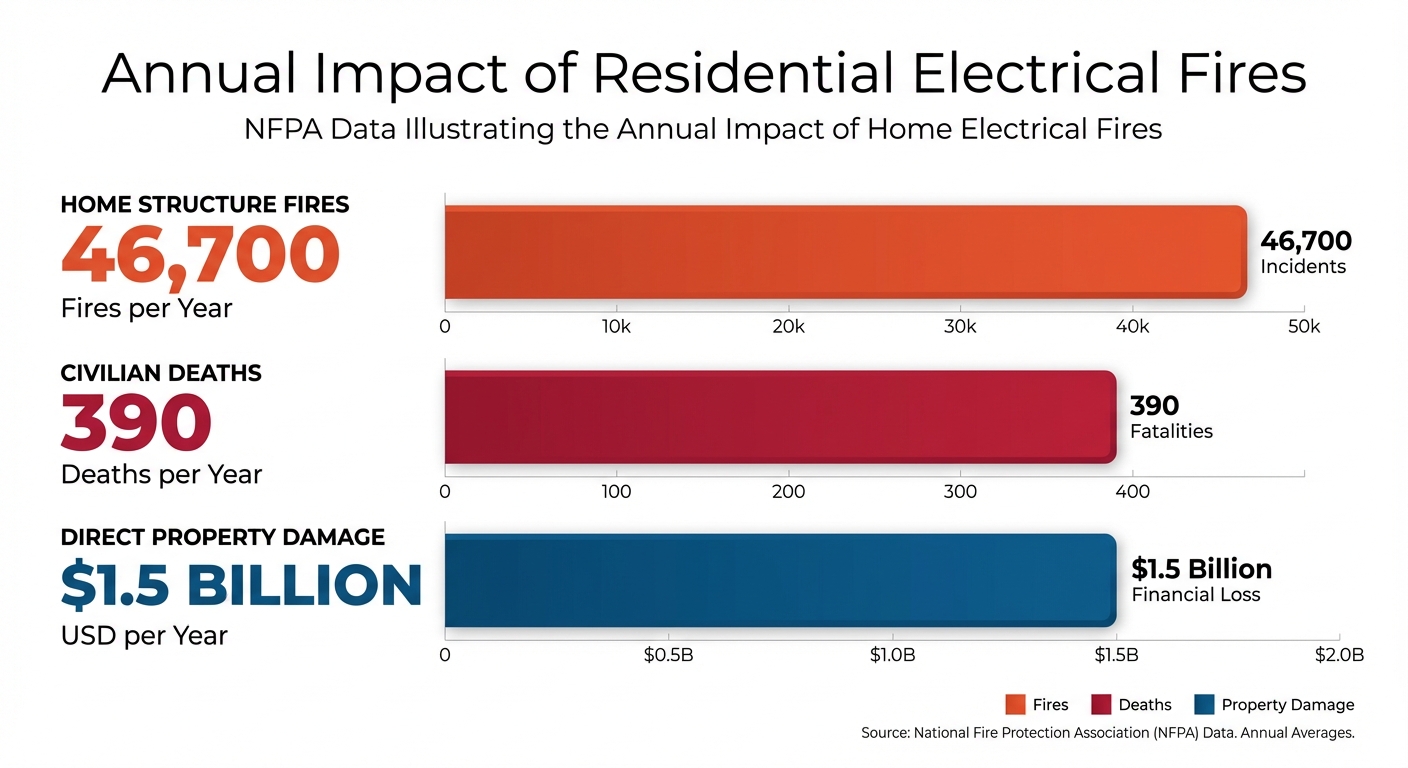
Electrical malfunctions account for 46,700 home structure fires annually in the U.S., causing approximately 390 civilian deaths and $1.5 billion in direct property damage each year. Unlike water damage from plumbing, electrical faults remain invisible inside walls until they trigger fires, often during peak electrical usage when families are home.
The Electrocution Risk
The Electrical Safety Foundation International reports thousands of emergency room visits annually for electrical shocks and burns in residential settings. What’s more concerning is that non-fatal electrical shock can cause long-term neurological damage that often goes unreported in immediate injury statistics. Unlike commercial settings where workplace electrical injuries have decreased due to OSHA oversight, residential electrical injuries remain a persistent problem with no regulatory oversight. When you work on your own home’s electrical system, there’s no safety officer checking your approach, no job site supervisor enforcing protective equipment requirements, and no backup system if something goes wrong.
The Cognitive Trap
The Dunning-Kruger Effect explains why homeowners with minimal electrical knowledge overestimate their ability to perform electrical work safely. This cognitive bias—where people with low ability at a task overestimate their competence—becomes particularly dangerous when applied to electrical systems. A National Institutes of Health study analyzing DIY content found that a significant portion of user-generated tutorials lack adherence to safety standards, creating false confidence in viewers. “YouTube University” shows how to complete a task but rarely explains the why behind code requirements—leaving homeowners unprepared when they encounter anomalies or older wiring systems that don’t match the tutorial.
The Pacific Northwest Context
The risks become even more acute in our region. Older homes in Portland and Vancouver—many built in the 1960s and 1970s—often contain aluminum wiring, knob-and-tube systems, or undersized panels that require specialized knowledge to work with safely. The Pacific Northwest’s increasing adoption of electric vehicles and heat pumps places unprecedented demands on residential electrical systems designed decades ago. Meanwhile, our region’s wet weather creates additional GFCI protection requirements that DIYers frequently overlook, not understanding that moisture and electricity create a lethal combination.
What Goes Wrong: Technical Failures That Create Hidden Hazards
Amateur electrical work fails not because devices don’t power on, but because installations violate the National Electrical Code in ways that create latent hazards. These five common mistakes reveal why “it works” doesn’t mean “it’s safe.”
Mistake #1: Reversed Polarity (The Hot/Neutral Swap)
One of the most insidious mistakes in outlet replacement is reversing the hot and neutral wires. In a properly wired outlet, the switch interrupts the “hot” wire. When reversed, the appliance functions normally—but the socket remains energized even when the device is “off.” This creates a significant shock hazard during lightbulb changes or appliance maintenance. The person performing routine maintenance has no way of knowing that what should be a dead circuit is actually carrying deadly current. The appliance works perfectly, masking the danger for years until someone receives a potentially fatal shock.
Mistake #2: Overfilled Junction Boxes
NEC Article 314.16 specifies maximum conductor counts based on box volume—a calculation most DIYers never perform. They simply force as many wires as possible into the box, figuring that if it closes, it’s fine. Overcrowding prevents heat dissipation. As current flows and wires heat up, insulation needs adequate air space to prevent melting. Without it, insulation degrades, leading to exposed conductors that arc and spark. This is a primary hidden cause of fires inside walls that don’t trigger breakers until substantial damage occurs.
Mistake #3: Improper Grounding
Many Pacific Northwest homes built before 1970 have two-prong outlets. DIYers often install modern three-prong outlets without establishing a proper ground path, creating the appearance of safety without the actual protection. Without the Equipment Grounding Conductor (EGC), fault current uses the appliance—or the person touching it—as the path to earth. This violation is particularly common in bathroom and kitchen updates where homeowners want modern outlets but don’t want to run new wire through finished walls. The result is an outlet that looks safe but offers no protection against electrical shock.
Mistake #4: Wire Gauge Mismatches (The Overload Trap)
Standard 15-amp circuits require 14-gauge wire; 20-amp circuits require thicker 12-gauge wire. DIYers experiencing nuisance tripping often “solve” the problem by installing a larger breaker on existing wire—allowing the wire to overheat beyond its rating. This reverses the fundamental safety principle of electrical systems. The breaker exists to protect the wire, not the appliance. When you upsize the breaker without upsizing the wire, the wire becomes the fuse instead of the breaker. The wire overheats, melts insulation, and causes fires inside walls before the oversized breaker ever trips.
Mistake #5: Ignoring AFCI/GFCI Requirements
Modern code requires Arc-Fault Circuit Interrupters (AFCI) in living areas and Ground-Fault Circuit Interrupters (GFCI) in wet locations. These devices detect dangerous conditions that standard breakers miss entirely. DIYers replacing standard breakers with standard breakers miss code updates requiring AFCI protection to detect dangerous arcing from loose connections. The U.S. Consumer Product Safety Commission identifies lack of proper circuit protection as a major factor in residential electrical fires. Without AFCI protection, a loose wire connection can arc for months, slowly carbonizing the wood framing around it until ignition occurs.
Beyond Safety: How DIY Electrical Work Destroys Your Investment
The immediate cost savings of DIY electrical work evaporate when insurance claims are denied, home sales fall through, or unpermitted work forces expensive emergency corrections. For Pacific Northwest homeowners, understanding regional permitting requirements isn’t optional—it’s essential to protecting your property value.
Insurance Coverage Denials
Homeowners policies require work performed in a “workmanlike manner” adhering to local codes. When a fire occurs, insurance investigators specifically examine electrical origins. Amateur wiring that was never inspected becomes grounds for claim denial. Even if your claim is initially paid, insurance companies pursue “subrogation” against homeowners for negligent work. This can lead to policy cancellation and permanently higher premiums across all carriers. The real-world impact is staggering: a $200 DIY outlet replacement can void coverage on a $500,000 home fire claim.
Washington State Requirements
Washington’s Department of Labor & Industries allows homeowners to do electrical work only if they occupy the residence and obtain proper permits and inspections. This means flippers, landlords, and non-occupant owners cannot legally perform their own electrical work—only licensed electricians can. Failure to permit results in civil penalties and creates title issues that can prevent home sales. When violations are discovered during home inspections, they must be corrected by licensed contractors before closing. Because the electrician must troubleshoot and certify unknown work, these corrections often cost 30-50% more than doing it right initially.
Oregon Regulations
Oregon requires permits for virtually all electrical work beyond replacing existing devices. The state’s “minor label” program is generally reserved for licensed contractors, meaning homeowners face the full permit process even for small jobs. Unpermitted work discovered during point-of-sale inspections becomes a negotiating liability. Buyers use code violations to demand price reductions or walk away entirely, particularly in competitive markets where they have multiple options.
Real Estate Transaction Impact
Certified home inspectors specifically flag “handyman specials”: double-tapped breakers, ungrounded three-prong outlets, missing GFCI protection in wet areas. These red flags immediately raise questions about what else might be wrong with the home. Buyers routinely demand corrections or price reductions. Professional electricians must diagnose and trace unknown wiring paths before certifying the system—a time-intensive process that drives up emergency correction costs. In competitive markets, homes with known electrical issues sit longer and sell for less than comparable properties with clean electrical systems.
The Appraisal Impact
Unpermitted electrical work can affect home appraisals, particularly for significant additions like sub-panels or service upgrades. Lenders may require corrections before loan approval if inspections reveal code violations, potentially derailing your buyer’s financing and killing the sale entirely.
Your Parents’ Home Wasn’t This Complicated: The Rising Electrical Demand
The electrical work your father did in 1975 bears little resemblance to modern residential electrical systems. Today’s homes carry unprecedented loads that make amateur work exponentially more dangerous.
The Historical Context
Homes built in the 1970s typically had 60-100 amp service panels designed for basic lighting, refrigeration, and minimal AC use. The modern standard is 200-amp service to accommodate HVAC, electric vehicle chargers, and dozens of high-draw appliances simultaneously. The complexity gap between then and now makes historical “my dad did it” comparisons dangerously irrelevant. Your father’s electrical work might have involved adding a light fixture to a circuit with significant spare capacity. Today’s work often involves sophisticated load calculations to ensure the system can handle multiple high-draw devices operating simultaneously.
Electric Vehicle Chargers
Level 2 EV chargers draw 40-50 amps continuously—equivalent to running an electric dryer non-stop for hours. Installation requires NEC Article 625 continuous load calculations that account for total panel capacity and demand factors. DIY installations frequently overload main service feeds, causing busbar failures that require $3,000+ emergency panel replacements. Improper EV charger installation can also void both the charger warranty and vehicle warranty, leaving you without recourse when equipment fails. For safe and professional electric car home charger installation, trust licensed electricians who understand the complexities.
Heat Pump Systems
The Pacific Northwest’s push toward electric heating dramatically increases winter electrical loads. Modern heat pumps with auxiliary heat can draw 15,000+ watts during cold snaps—the equivalent of running 150 old-style incandescent bulbs simultaneously. Adding heat pump circuits to older panels requires professional load calculations to prevent service drops during peak demand. When your heat pump, EV charger, electric dryer, and electric water heater all operate simultaneously on a cold winter evening, the system must be engineered to handle that worst-case scenario. Professional heating and air conditioning wiring ensures your system can safely support these modern demands.
Smart Home Technology
Low-voltage smart home systems still require proper integration with line-voltage circuits. Mixing automation with electrical systems requires understanding of both electrical code and communication protocols—knowledge that extends far beyond basic wiring. Improper integration can cause “phantom loads” that drain circuits and confuse troubleshooting. More concerning, some smart switches require neutral connections that older homes lack, leading DIYers to make dangerous improvised connections. Professional smart home automation installation ensures safe integration with your existing electrical infrastructure.
The Diagnostic Challenge
Professional electricians use thermal imaging to detect hot spots invisible to the naked eye, load analyzers to verify capacity, and specialized testers for AFCI/GFCI function. Modern electrical problems require root cause analysis beyond “does it work?” Intermittent problems—the hardest to solve—require systematic analysis that YouTube tutorials can’t provide. When a circuit works fine most of the time but trips randomly, identifying whether it’s a loose connection, an intermittent ground fault, or a defective device requires diagnostic tools and training that amateurs simply don’t possess.
When DIY Goes Wrong: Three Cautionary Tales from the Field
These real-world scenarios demonstrate how amateur electrical work creates hidden time bombs that detonate years after the initial “successful” installation.
Case Study 1: The Buried Junction Box
During a kitchen remodel, a homeowner buried a live junction box behind drywall to install cabinetry rather than relocating the box. Years later, a loose connection inside the inaccessible box began arcing. Because the box couldn’t be diagnosed without demolition, the fault remained undetected until arcing heat ignited the drywall paper, causing significant fire damage.
Case Study 2: The Aluminum Wiring Disaster
In a 1970s-era Portland home with aluminum wiring (common in that era), a homeowner replaced a receptacle, connecting copper wire to existing aluminum without proper connectors. Aluminum and copper expand at different rates when heated, causing the connection to loosen over time. This led to oxidation, high resistance, and eventually a melted outlet with significant smoke damage requiring extensive remediation.
Case Study 3: The EV Charger Overload
A Vancouver homeowner installed a Level 2 EV charger on a detached garage sub-panel without performing a load calculation on the main service. When the EV charger, electric dryer, and AC ran simultaneously, the main busbar overheated. The breaker didn’t trip due to heat curve characteristics, resulting in total main panel failure requiring emergency replacement at $3,500+ plus lost work time.
Beyond Wire Nuts: The Value Professional Electricians Bring
Understanding what professional electrical service actually includes reveals why the “labor cost” represents value, not expense. Licensed electricians bring systematic analysis, code expertise, and accountability that no tutorial can replicate.
Comprehensive Assessment
Professional electricians evaluate the entire system context, not just the immediate task. We use thermal imaging to identify hot spots invisible to the eye, load analysis to verify capacity before adding circuits, and panel evaluation to determine if upgrades are necessary before starting work. This comprehensive approach catches problems before they become emergencies. An outlet replacement becomes an opportunity to verify proper grounding throughout the circuit, check for backstabbed connections that might fail in the future, and ensure GFCI protection extends to all required locations. Professional safety inspections provide peace of mind that your entire system meets current safety standards.
Code Compliance & Permitting
Licensed contractors stay current with NEC updates and local amendments through continuing education requirements. Professional work includes proper permitting and inspection coordination, creating documentation that protects property value and insurance coverage. Sarkinen Electrical ensures all work meets Washington L&I and Oregon building code requirements. This paper trail proves to future buyers, inspectors, and insurance adjusters that your home’s electrical system was professionally maintained according to current safety standards.
Insurance & Liability Protection
Licensed, bonded, and insured contractors transfer liability away from homeowners. Professional errors are covered by contractor insurance, not your homeowners policy. Proper licensing ensures recourse if problems arise after project completion. When you hire Sarkinen Electrical, you’re not just paying for technical expertise—you’re purchasing protection against catastrophic liability that DIY work leaves squarely on your shoulders.
Long-term Value
Permitted, professional electrical work increases property value and marketability. Clean inspection reports accelerate home sales and eliminate negotiation leverage for buyers who might otherwise demand price reductions for code violations. Professional installations come with warranties and ongoing service relationships. When you need future work or troubleshooting, we have detailed records of your home’s electrical configuration, dramatically reducing diagnostic time and cost.
Diagnostic Capability
Professionals troubleshoot root causes, not just symptoms. Our experience with regional housing stock includes Pacific Northwest-specific issues like moisture intrusion affecting electrical systems, aluminum wiring requiring specialized connections, and undersized panels common in homes from the 1960s-70s. We have access to specialized tools and testing equipment unavailable to homeowners: insulation resistance testers, clamp-on ammeters, circuit tracers, and thermal imaging cameras that reveal problems before they cause failures.
Time & Efficiency
What takes a DIYer a full weekend takes professionals 2-3 hours, reducing household disruption and allowing faster return to normal life. There’s no “learning curve” mistakes requiring rework, no trips back to the hardware store for forgotten parts, and no evenings spent researching why the circuit still doesn’t work properly.
Final Thoughts
The DIY spirit has a valuable place in home maintenance—just not in your electrical panel. While the $800 billion home improvement market thrives on homeowner self-sufficiency, the statistics paint a sobering picture: 46,700 annual electrical fires, 390 deaths, and $1.5 billion in property damage from electrical malfunctions tell us that this is one area where professional expertise isn’t optional. For Vancouver and Portland homeowners, the complexity of modern electrical systems—from EV chargers to heat pumps to smart home integration—has transformed electrical work from a simple skill into a specialized discipline requiring years of training and continuous education. The National Electrical Code, Washington L&I requirements, and Oregon building codes exist not to generate paperwork, but to protect lives and property. The “hidden cost” of DIY electrical work isn’t measured at the hardware store checkout. It’s paid in denied insurance claims, failed home inspections, emergency repairs at midnight, and the devastating realization that saving $300 on labor cost you tens of thousands in consequences. When Sarkinen Electrical talks about safety and code compliance, we’re not engaging in self-serving rhetoric—we’re articulating a philosophy built on decades of evidence. Putting down the pliers isn’t admitting defeat. It’s making a strategic decision to protect your family, your home, and your investment. Some projects are worth doing yourself. Electrical work isn’t one of them.
Ready to Protect Your Home with Professional Electrical Service?
Don’t risk your family’s safety or your home’s value with DIY electrical work. Contact Sarkinen Electrical for a consultation on your next electrical project—because your home’s safety is too important for trial and error.
References:
- Global Market Insights. (2024). DIY Home Improvement Market Size.
- National Fire Protection Association (NFPA). (2022). Home Electrical Fires.
- Electrical Safety Foundation International (ESFI). (2023). Workplace and Home Electrical Injury Statistics.
- National Institutes of Health (NIH). (2021). Analysis of Safety Information in DIY YouTube Videos.
- EC&M. (2023). Box Fill Calculations: What You Need to Know.
- The Spruce. (2024). Matching Wire Size to Circuit Amperage.
- U.S. Consumer Product Safety Commission (CPSC). (2011). Repairing Aluminum Wiring.
- Insurance Information Institute. (2024). Does My Homeowners Insurance Cover Fire Damage?
- Washington State Department of Labor & Industries (L&I). (2024). Electrical Permits, Fees, and Inspections.
- U.S. Department of Energy. (2024). Upgrade Your Home Electrical Panel.
- UpCodes. (2023). 2020 National Electrical Code: Accessibility of Boxes.